

‘Ebola takes the people children depend on’: United Nations Children’s Fund (UNICEF)

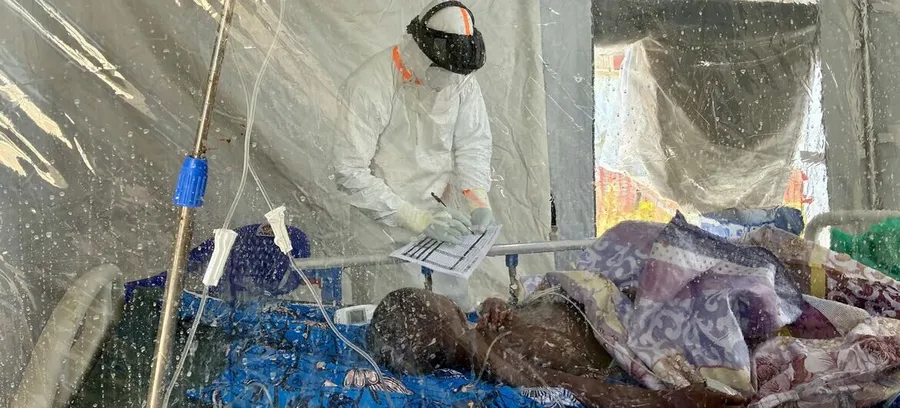
The update comes as neighbouring Kenya confirmed its first case and death from the disease, believed to have come from DRC.
“Ebola takes the people children depend on and unravels their lives,” said Halimatou Amadou, UNICEF Chief of Communication in the DRC, speaking to journalists in Geneva.
“The parents fall ill, a child may be exposed, the parent is taken for treatment or dies. At the very moment a child most needs someone, fear and stigma can keep relatives and neighbours away.”
**Nearly 2,000 children affected **
More than 1,900 boys and girls have either lost one or both parents, or their caregivers, since the outbreak was declared in May, or have been separated from them.
Most of these children, 1,581, are in North Kivu province, the epicentre of the crisis. A further 322 are in neighbouring North Kivu province.
“And these are the children we know about because these figures cover only the area where UNICEF works with social affairs teams in the affected provinces,” she said.
**Fighters and survivors **
Ms. Amadou put names behind the numbers, such as Lina*, a seven-month-old girl who she met at a UNICEF-supported nursery next to an Ebola treatment centre in Bunia, the Ituri capital.
Lina’s mother died and her father is missing. Her grandfather, who lives nearby, has visited twice and the hope is that they will soon be together.
Another child, Raphael*, just eight months old, survived Ebola but lost eight family members. He stayed at the nursery for more than three weeks until his older brother could take him home.
**Young lives lost **
“Children are not only losing their parents. They're also losing their own lives,” Ms. Amadou said.
As of 29 September, at least 2,017 children had been confirmed with Ebola in DRC. At least 1,062 have died.
She noted that children make up just over one in four confirmed cases, but around one in three deaths. However, the situation is worse among under-fives where the death rate is seven in 10, up from six in 10 just a few weeks ago.
“Many die before the virus is ever detected, before they ever reach treatment,” she said.
**Care and access **
While in Bunia Ms. Amadou “also saw what works” for young lives upended by Ebola.
UNICEF supports 12 nurseries in Ituri and North Kivyu that care for babies and young children who have been exposed to the virus, or whose parents are in treatment, or who are on their own.
“Children are fed, they are held, they're cared for, they are also watched closely so that if symptoms appear, they get paediatric care fast,” she said.
UNICEF is calling for nurseries at every Ebola treatment centre in the DRC, while underscoring the need to maintain health essential services. That way children receive early detection and quick referral to Ebola care, as well as protection from common childhood diseases.
**First case in Kenya **
Meanwhile, the World Health Organization (WHO) is monitoring the situation in Kenya, which on Tuesday confirmed its first case and fatality, according to media reports.
Spokesman Christian Lindmeier the case was “likely imported from DRC” but more information was not available.
He said colleagues on the ground are working with the Kenyan authorities to get more details.
Distributed by APO Group on behalf of UN News.
About this article
- Length
- 548 words · 3 min read
- Published
- October 6, 2026
- Source
- Africa Newsroom