

From discarded materials to 50 000 products: Meet Lizl Naudé

AI summary
A discarded wine bottle, a piece of plastic or an offcut of timber may appear to have little value once its original purpose has been served. For entrepreneur Lizl Naudé, however, these materials can become the starting point for a new product – and, potentially, an entirely different business opportunity.
Naudé is the founder of Lilly Loompa, a South African circular-design business that transforms discarded materials into homeware, hospitality products, tourism merchandise and corporate gifts.
Established with her husband, Ashley, the company has grown from a family income initiative into an enterprise that has created more than 50 000 products and completed over 100 collaborative projects.
Its approach comes at a time when waste management and resource efficiency remain important issues for South African businesses and communities.
In the Western Cape, recent environmental initiatives have also highlighted the work involved in keeping discarded materials out of rivers, public spaces and landfill sites. A community-led project that removed more than 14 tonnes of litter from the Soet River, for example, demonstrated the scale of local waste challenges and the role of partnerships in addressing them.
For Naudé, however, the conversation does not end with collecting and sorting waste, as her business is built around what happens next: finding practical ways to turn those materials into products that people and organisations are willing to buy.
A family initiative becomes a business
Picture: Supplied
Lilly Loompa was established by Naudé and Ashley during a difficult period when generating an income for their family became a priority.
What began as a practical way to make use of available resources gradually developed into a business focused on design, material reuse and commercial partnerships.
‘I’ve had to navigate some really difficult seasons in my life, and I think that’s where the heart of Lilly Loompa comes from,’ says Lizl.
‘When you’re faced with challenges, you learn to look at things differently. I started looking at what was available to me, rather than what I didn’t have. Waste became a resource, something I could work with, build from and turn into an income. What began as a way forward for my family has grown into a business with the potential to create opportunities for so many others.’
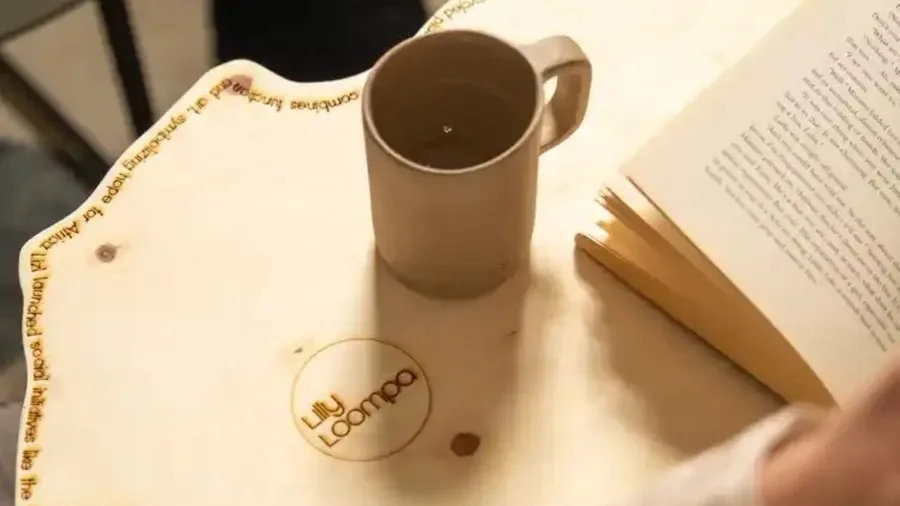
Today, the company works with discarded glass, recycled plastics and reclaimed timber, developing products for both individual customers and organisations. Its offering includes homeware and hospitality items, as well as bespoke merchandise and corporate gifts.
The business has also moved beyond producing items from materials it sources independently. It works with companies and brands to identify waste generated through their own operations and explore whether those materials can be incorporated into new products.
One example is Lilly Loompa’s collaboration with Protea Wines. Bottles used at the winery are collected and delivered to the business, where they are transformed into products that are then sold through the winery’s tasting room.
The arrangement creates a link between the material a business discards and a new product it can offer its customers. It also gives the organisation a tangible way to demonstrate its approach to reuse.
For Naudé, the commercial potential is just as important as the environmental purpose.
‘I’ve always believed that there’s potential in things people overlook or throw away. When I look at a piece of plastic, a discarded bottle or a piece of timber, I start imagining what it could become. But the exciting part is taking that idea further, creating something people actually want, finding a market for it and making it commercially viable. Waste shouldn’t simply be something a business has to get rid of. It could be an asset, a source of income and the beginning of something new.’
That thinking has shaped the company’s broader services, which include corporate gifting, custom product development, waste-to-value projects and environmental, social and governance (ESG) consulting.
Rather than focusing only on sustainability reporting, Lilly Loompa aims to help organisations develop products and campaigns that make their resource-use commitments more visible to customers and employees.
Taking the circular economy beyond the workshop
Picture: Supplied
The company says it has created more than 50 000 products, completed over 100 collaborative projects and started exporting to markets including the United States, the United Kingdom and Europe.
With increased production capacity and improvements in machine efficiency, the next stage involves expanding its offering and reaching additional markets.
There are also plans to explore partnerships with municipalities and industry players, including potential creative projects linked to South Africa’s electric vehicle sector.
One longer-term ambition is to develop a model through which communities can earn an income by collecting and supplying recyclable materials.
The initiative is still in development, but the intention is to create additional opportunities for people to participate in the circular economy while providing businesses with access to reusable materials.
Naudé says the company’s ambitions extend beyond the products it manufactures.
‘I don’t want Lilly Loompa to be seen only as a business that makes products from waste,’ she highlights.
‘I want us to be part of a much bigger conversation about how we manage resources, how we create income and how we bring businesses and communities together. There is so much potential in what we are throwing away. We need to start looking at it differently.’
For co-founder Ashley Naudé, the issue is also connected to how organisations produce, purchase and use resources.
The business aligns its approach with the United Nations Sustainable Development Goal 12, which focuses on responsible consumption and production. The goal encourages more efficient use of resources and a reduction in waste across production and consumption systems.
‘As advocates of the United Nations’ Sustainable Development Goal 12, Responsible Consumption and Production, we believe the world’s challenge is not necessarily a shortage of energy or food, but how we consume and use the resources we already have,’ says Ashley.
‘Consider that around a third of all food produced globally is lost or wasted. We leave lights burning unnecessarily, discard materials that still have value and consume resources without fully considering the consequences. We need to rethink not only how we produce, but how we consume. Sustainability isn’t simply about making more; it’s about making better use of what we already have, reducing waste and taking greater responsibility for the resources at our disposal.’
Lilly Loompa’s work offers one example of how design and commercial partnerships can form part of that process. Its longer-term plans also point to the potential for connecting businesses with communities that can supply recyclable materials.
The company is now looking to build relationships with more brands, organisations and industry partners as it expands its production and export footprint.
Picture: Supplied
Be the first to know – Join our WhatsApp Channel for content worth tapping into! Click here to join!
Also read:
Picture: Supplied
The post From discarded materials to 50 000 products: Meet Lizl Naudé appeared first on Cape Town ETC.
Follow the story
About this article
- Length
- 1,161 words · 6 min read
- Published
- November 12, 2026
- Byline
- Lulama Klassen
- Source
- Cape Town ETC