

Lamola warns against erosion of international law

AI summary
International Relations and Cooperation Minister Ronald Lamola has warned that the weakening of international law and multilateral institutions poses a wider threat to global stability, amid growing conflict.
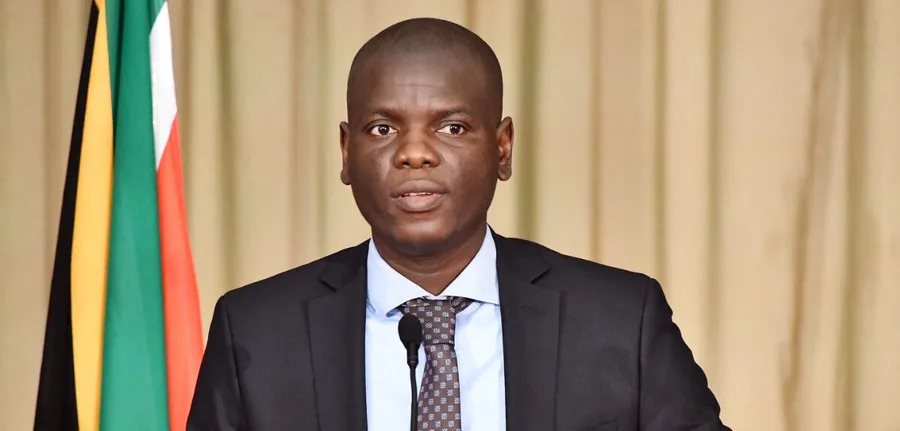
Lamola was speaking at The Riverside Church in New York City on Monday, September 21, during a special event commemorating the United Nations Charter.
“We also act because we know that the current attacks on international law and multilateralism are part of a bigger crisis confronting humanity,” he said.
He used the Israeli-Palestinian conflict as one of the clearest examples of what he described as the failure to uphold international law.
“For Palestinians, the age of freedom is yet to dawn. The hour of peace is yet to strike,” Lamola said.
He accused Israel of actions that were damaging the prospects of a two-state solution, citing the annexation of Palestinian territory, the destruction of livelihoods and continued violence in Gaza and the West Bank.
Lamola also highlighted the destruction of essential infrastructure, including hospitals, schools, water and sanitation facilities, as well as the humanitarian consequences for Palestinian civilians.
READ: The cartography of genocide
He said the international community was witnessing the evidence of the destruction while failing to respond adequately.
“This is why we cannot afford to bury international law,” Lamola said.
South Africa has been at the forefront of the condemnation of Israel’s attacks on Gaza. Pretoria also launched an application against Israel before the International Court of Justice on December 29, 2023, alleging that Israel was responsible for violations of the Convention on the Prevention and Punishment of the Crime of Genocide (Genocide Convention) in Gaza. South Africa also requested the court to indicate provisional measures orders considering the urgency and gravity of the situation.
But his address was not limited to the Israeli-Palestine conflict.
Lamola argued that the weakening of international law and multilateralism formed part of a much broader crisis affecting the global political and economic system.
He linked that crisis to growing inequality, the rise of populism and shortcomings in the global financial system. Lamola said developing countries continued to carry a disproportionate burden from global challenges while having limited influence over institutions responsible for major international decisions.
“Today, run-away inequality is eroding faith in democracy and opening the door to populists who set the poor against each other,” he said.
READ: Ramaphosa receives landmark G20 report urging global action on inequality
He also criticised the imbalance in global financial institutions, arguing that the existing architecture continues to favour wealthier nations. For South Africa, Lamola said, the lack of adequate African representation in international institutions remained a particular concern.
“African countries are under-represented in institutions where decisions affecting our future are made,” he said.
Lamola further pointed to several conflicts to illustrate the strain on the international system, including the war in Sudan, fighting in eastern Democratic Republic of Congo (DRC) and the Russia-Ukraine conflict.
He described Sudan’s conflict as the world’s largest humanitarian and displacement crisis and said the wars in the Middle East and eastern DRC continued to cause widespread suffering.
Speaking about the Ukraine, Lamola said the United Nations had been unable to end the war, which has now entered its fourth year.
He also raised concerns about the lack of progress towards the Sustainable Development Goals, saying the targets remained out of reach with less than four years remaining before the 2030 deadline.
Lamola contrasted the resources being devoted to military spending with those available to the United Nations.
“Global military spending is now almost 800 times the UN’s regular budget,” he said.
Follow the story
About this article
- Length
- 594 words · 3 min read
- Published
- September 22, 2026
- Byline
- Queenin Masuabi
- Source
- Sunday World