

Beyond new weapons: Can Nigeria’s growing military partnerships end insecurity?

AI summary
Nigeria’s latest receipt of military equipment from the United States has renewed attention on the country’s security partnership with Washington and whether additional firepower can help reverse years of insurgency and armed violence.
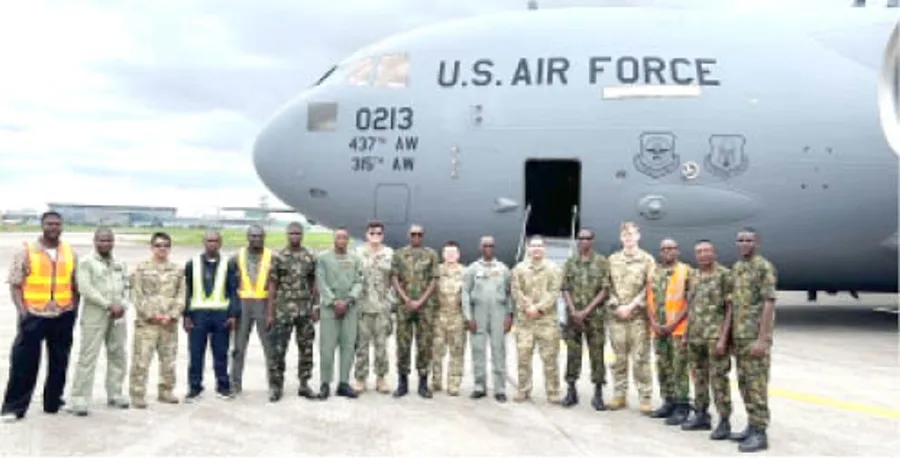
The equipment arrived aboard a US Air Force C-17 Globemaster III aircraft under the Foreign Military Sales programme, according to the United States Africa Command (AFRICOM), which announced the delivery on its official X account.
Although the value and specifications of the latest consignment were not disclosed, the Presidency welcomed the delivery as evidence of stronger defence cooperation between both countries.
The President’s special adviser on information and strategy, Bayo Onanuga, shared AFRICOM’s announcement, stating, “A United States Air Force C-17 aircraft has delivered military equipment to the Nigerian Air Force as part of the partnership agreement between the two countries.”
The arrival comes amid Nigeria’s continuing battle against terrorist groups and insurgents, as well as recent changes in its military engagement with the United States.
Relations between both countries faced renewed tensions after US President Donald Trump redesignated Nigeria a “Country of Particular Concern”, accused the administration of President Bola Tinubu of condoning killings and threatened military action.
Subsequent diplomatic engagements led to visits by officials from both countries, the deployment of American special forces and joint operations targeting terrorist groups.
However, the commander of AFRICOM, Dagvin Anderson, announced last month that the United States had withdrawn many of its troops following an operation in May that killed Abu-Bilal al-Minuki, described as the second-in-command of the Islamic State group in the Lake Chad Basin.
A smaller contingent of trainers and intelligence analysts was expected to remain after the larger deployment ended by late September.
The latest equipment delivery therefore comes as the two countries maintain security cooperation despite a reduction in the American military presence.
A deal whose details remain unclear
The consignment has also drawn attention because it arrived about a year after the United States notified Congress of a proposed $346m sale of defence equipment and services to Nigeria.
In a letter dated August 13, 2025, the Defence Security Cooperation Agency informed the Speaker of the US House of Representatives, Mike Johnson, of the proposed transaction.
The listed equipment included 1,002 MK-82 general-purpose bombs, components for precision-guided bombs, 5,000 Advanced Precision Kill Weapon System II rounds and associated technical and logistical support.
Other items were expected to include programmable fuzes, rocket components, testing equipment and engineering services.
However, it remains unclear whether the equipment recently delivered to Nigeria forms part of that proposed sale.
The congressional notification said the deal was intended to strengthen Nigeria’s ability to respond to terrorist organisations and combat illicit trafficking in the country and the Gulf of Guinea.
It also stated that the proposed sale would not alter the region’s basic military balance.
More equipment, but no quick solution
Retired Major General Umar I. Mohammed described the latest delivery as a positive development in military relations, noting that the United States had previously been reluctant to supply Nigeria with equipment.
“It’s actually an indication of a growing US-Nigeria relationship, especially militarily. So, it’s an indication that we’re getting closer to one another in terms of the military. One of the key problems we had before is the fact that the US was actually reluctant to support us with equipment. So, I think it’s very positive that they are giving us equipment,” he said.
However, Mohammed cautioned that improved military capacity should not be mistaken for an immediate end to insecurity.
“You see, the question is that there is what is called a threat analysis. When you say threat analysis, the threat is not in relation to the equipment you have. There are so many things that spark a crisis,” he said.
He explained that additional equipment could help troops respond more effectively when threats emerged, rather than prevent every security crisis from occurring.
“If you have more equipment, that means you are being made more capable of dealing with the threat when it emerges. The emergence of a threat, people coming out, people starting to attack, has no relationship with an increase in the equipment you have. It just means that if you have more equipment and if they come out, it gives you more power, more capacity to be able to handle them better than when you have less equipment,” he added.
The retired general said he could not assess the latest delivery’s operational value without knowing precisely what had been supplied.
He expressed a preference for armed helicopters, which he considered useful for Nigeria’s counter-insurgency operations.
“I would have been very happy if I saw armed helicopters. Because armed helicopters are what we need in this kind of fighting that we are involved in,” he said.
Mohammed also warned against expecting an immediate resolution to the conflict, which he said had lasted 17 years.
“I want you to understand that this insurgency has been going on for 17 years. So, it doesn’t mean that within one day the whole problem will be solved,” he said.
A wider network of defence suppliers
The United States is one of several countries supplying Nigeria with military equipment, alongside partners including Turkey, China, South Korea, Russia, South Africa, Pakistan and Italy.
Nigeria has also pursued defence cooperation with Saudi Arabia, France and the United Kingdom through arrangements covering training, intelligence sharing, equipment and other forms of military support.
Its long-standing relationship with Washington includes the supply of 12 A-29 Super Tucano aircraft under a $497m deal announced in 2017, while Nigeria made its first payment in August 2025 towards a $997m purchase of 12 AH-1Z attack helicopters.
The broader partnership has also included training on international humanitarian law and efforts to improve procedures aimed at reducing civilian casualties during military operations.
Ultimately, the latest delivery adds to Nigeria’s military resources, but its practical impact will depend on the equipment supplied, how effectively it is deployed and whether it forms part of a sustained strategy against insecurity.
The post Beyond new weapons: Can Nigeria’s growing military partnerships end insecurity? appeared first on WITHIN NIGERIA.
Follow the story
About this article
- Length
- 1,013 words · 5 min read
- Published
- October 18, 2026
- Byline
- JustAbdul
- Source
- Within Nigeria