

Red light for robot thieves as lights vandalised
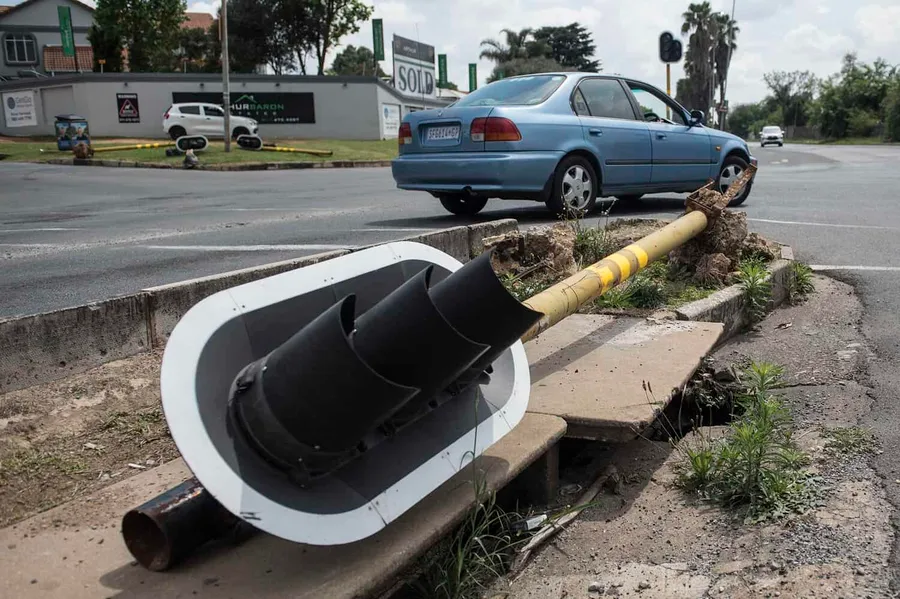
Joburg Roads Agency says more than 300 traffic lights have been vandalised and stripped of equipment across Johannesburg.

AI summary
In July, Kariega businessman Jevon Dyer loaded five broken traffic lights onto a trailer and left them outside the Nelson Mandela Bay municipality’s customer care office.
When Daily Maverick visited about a week later, they were still lying there, with no apparent attempt to move them.
Dyer has owned businesses in Kariega (formerly Uitenhage) for more than two decades.
The lights outside his shop in Caledon Street had been out for months and he had seen several accidents and near misses at the intersection.
“I thought, why not? I was just tired,” he said. He has since earned the nickname “Mr Robot”.
He is not alone. In Pietermaritzburg, The Witness reported in September residents wait almost an hour in afternoon peak traffic when the lights on key routes are out.
In Wynberg, Johannesburg, the lights at the corner of Chadwick Avenue and 5th Street were out for more than a year when the* Sandton Chronicle* asked for a repair date in July.
The Joburg Roads Agency (JRA) said there was none.
The intersection is rated “priority four”.
JRA says more than 300 of Joburg’s traffic light have been vandalised and stripped of equipment.
Ekurhuleni spent roughly R120 million on repairs in a single financial year before replacing lights at some high-risk intersections with stop signs, BusinessTech reported.
The Automobile Association does not install or maintain traffic lights. But the organisation is concerned about the issue.
At a dead intersection, the person most exposed is not the one behind the wheel, but the person on foot.
At a dead intersection, a driver waits and may lose an hour. A pedestrian has to gamble. The rule is clear: treat a broken traffic light as a four-way stop.
For people crossing on foot, mobility matters most. Mobility is not transport.
It is the freedom to change circumstances: to reach a job, keep it and get home safely.
Lebogang Tiego Legodi, a political scientist at Limpopo University, wrote for SABC News about the security guards, cashiers, cleaners and petrol attendants who walk to work before sunrise.
In parts of Polokwane, she wrote, they have done it without street lights for two years.
Legodi makes a sharper point. She says people who walk home in the dark are governed by people who live in secured gated communities. In mobility terms, that is a two-standard country: one standard for people who drive home through a boom gate, another for people who walk.
Before mobility, I worked in mergers and acquisitions, risk and health care.
That work teaches you organisations rarely fail for lack of assets, they fail because nobody owns the maintenance.
Days after Dyer’s protest, Nelson Mandela Bay’s head of roads and transport, Yolisa Pali-Jongilanga, told a council committee: “We cannot afford to continuously repair the same traffic lights every three months due to repeated acts of vandalism.”
National Treasury warned the repeated spending would be flagged in the audit.
“It almost seems as though we are feeding the thieves each time we do repairs.”
Replace a stolen controller without securing the cabinet it sits in, and the city pays for the same controller twice.
On the M17, she said, vandals stripped the lights seven weeks after the city repaired them.
In Joburg, vandals hit one intersection 14 times before the city replaced it with stop signs.
Each replacement costs around R300 000, according to BusinessTech.
The answer cannot be to stop repairing. Yet that is where several councils have landed.
Ekurhuleni says some of its new stop signs may become permanent. In Centurion, a signalised intersection has been downgraded to a three-way stop.
Dante Kemp, a DA councillor in Pietermaritzburg, told The Witness: “Vandalism cannot become an ongoing justification for leaving critical intersections without functioning signals.”
The cabinet can be secured. Cape Town has been piloting submersible chambers: wiring and components are sealed in buried concrete, with sensors that alert law enforcement when someone starts digging.
The city’s mayoral committee says some of its most problematic intersections now run smoothly,* TopAuto* reported in July.
If one city can engineer an end to the theft, every other city owes its residents a costed answer on why it cannot.
Ownership also means carrying a decision through.
In September last year a Nelson Mandela Bay councillor proposed the city recover the cost of crash-damaged traffic lights from negligent drivers or their insurers.
The motion was approved. In July, he told *Daily Maverick *the measure appeared not to have been implemented.
Gauteng’s roads department is responsible for 547 of the province’s more than 4 500 signalised intersections, TopAuto reported in August.
The rest is someone else’s. A driver at a dead robot cannot tell whose it is, whether anyone has reported it or when it will work.
I would ask every metro for three things:
- First, publish a register of every traffic and street light that isn’t working, including the responsible authority, a fault reference, a repair date and update it weekly.
- Second, treat traffic signal controllers like a bank treats cash: keep spares, secure the cabinets and track every unit.
- Third, repair the routes that matter most first: schools and the streets shift workers walk before sunrise and after dark.
Polling stations matter this year with local government elections looming.
Legodi recalls in 2024, queues in Polokwane were so long that some people voted at midnight. Business has a part to play.
Bosses can adjust shifts, organise transport and log every fault on the routes their staff use.
Dyer said he was trying to be “part of the solution and not the problem”. He should not have needed a trailer to do it.
Follow the story
About this article
- Length
- 938 words · 5 min read
- Published
- October 29, 2026
- Byline
- Bobby Ramagwede
- Source
- The Citizen