

INEC unveils plans for PWDs in 2027 polls, drives grassroot mobilisation
The Independent National Electoral Commission (INEC) has unveiled a grassroots mobilisation strategy to boost the participation of persons with disabilities read more INEC unveils plans for PWDs in 2027 polls, drives grassroot mobilisation

AI summary
The Independent National Electoral Commission (INEC) has unveiled a grassroots mobilisation strategy to boost the participation of persons with disabilities (PWDs) in the 2027 general elections, targeting 137,487 PWDs so far captured in its voter database.
The Commission said the figure makes sustained, targeted sensitisation imperative to ensure eligible PWDs are informed, mobilised and supported throughout the electoral process.
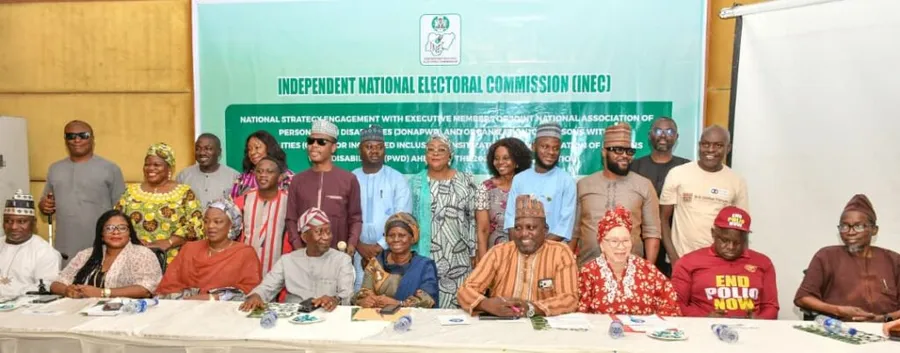
The disclosure was made on Wednesday in Abuja at a National Strategy Engagement with the Joint National Association of Persons with Disabilities (JONAPWD), Organisations of Persons with Disabilities (OPDs), development partners and other stakeholders.
The engagement focused on improving targeted sensitisation and mobilisation to increase turnout and participation of PWDs in 2027.
INEC Chairman, Joash Amupitan, who was represented by the Acting Chairman and National Commissioner, Rhoda Gumus, said the Commission was determined to ensure no eligible voter is excluded.
Gumus said the participation of PWDs is anchored on Section 54 of the Electoral Act 2026 (as amended), the Discrimination Against Persons with Disabilities (Prohibition) Act 2018 and INEC’s Framework on Access and Participation of Persons with Disabilities in the Electoral Process.
According to INEC, the 137,487 PWDs captured before its Automated Fingerprint Identification System (AFIS) exercise comprise 13,080 visually impaired persons, 9,299 hearing impaired persons, 30,561 persons with albinism, 19,430 persons with physical impairment and 54,941 persons in other disability categories.
Amupitan said the strategy would be replicated across the states through Resident Electoral Commissioners, Electoral Officers and other officials, with JONAPWD and OPDs expected to take ownership of sensitisation within their respective clusters.
He stressed that the initiative cannot be achieved by INEC alone, noting that disability organisations, civil society groups and PWDs themselves must play central roles in translating the strategy into practical interventions.
Earlier, the Director of INEC’s Gender and Inclusivity Department, Lakunuya Dorothy Bello, identified access to voter information, voter education, mobilisation and accessibility of electoral facilities as persistent challenges confronting PWDs. She called for campaigns that are targeted and delivered in accessible formats.
In her presentation, the Executive Director of Inclusive Friends Association (IFA), Grace Jerry, urged stakeholders to adopt a mobilisation model that maps PWD networks and priority gaps, leverages OPD networks and accessible media, provides voter education in multiple formats and establishes mechanisms for reporting and escalating barriers to INEC.
Jerry said the campaign must extend beyond conventional civic spaces to wards, local government areas, markets, campuses, faith-based organisations, community spaces and digital platforms.
JONAPWD National President, Comrade Abdullahi Aliyu Usman, commended INEC for its disability inclusion policy but warned that a single national engagement would not be sufficient to secure full participation of PWDs in 2027.
On his part, the Executive Secretary of the National Commission for Persons with Disabilities (NCPWD), Bar. Ayuba Gufwan Burki, highlighted mobility challenges, inadequate assistive devices and restrictions on movement during elections as continuing barriers.
Similarly, Founder and Chief Executive Officer of TAF Africa, Jake Epelle, urged INEC to improve accessibility at polling units and deepen grassroots mobilisation through OPD cluster heads across the 36 states and the Federal Capital Territory.
The engagement ended with the adoption of a communique setting out commitments and action points for stakeholders ahead of the 2027 general elections.
INEC’s latest initiative places disability inclusion firmly on the pre-election agenda, with stakeholders now expected to translate the Abuja commitments into state- and community-level mobilisation.
Follow the story
About this article
- Length
- 552 words · 3 min read
- Published
- September 17, 2026
- Byline
- Akombo Aondona
- Source
- BusinessDay