

Lagos-Calabar highway: When the original route hits a roadblock
The Federal Government’s decision to redirect part of the Lagos-Calabar Coastal Highway through the East-West Road corridor has sparked debate over project planning, construction costs and the potential impact on surrounding communities. The Minister of Works, David Umahi, said the adjustment was necessary because difficult terrain along the original route through Ondo State would have […] The post Lagos-Calabar highway: When the original route hits a roadblock appeared first on WITHIN NIGERIA .

AI summary
The Federal Government’s decision to redirect part of the Lagos-Calabar Coastal Highway through the East-West Road corridor has sparked debate over project planning, construction costs and the potential impact on surrounding communities.
The Minister of Works, David Umahi, said the adjustment was necessary because difficult terrain along the original route through Ondo State would have made construction significantly more expensive.
He maintained that the decision followed engineering assessments and was intended to protect public funds rather than serve political interests.
Why the route was changed
Umahi said the original alignment contained deep pits and lacked suitable sharp sand within the required depth for filling and ground stabilisation.
“You want me to pass through a terrain that is over 100 metres of pits deep, and I have no defined sharp sand up to 300 metres, and you expect the cost of one kilometre to be the same cost with a road passing through normal terrain?” he asked.
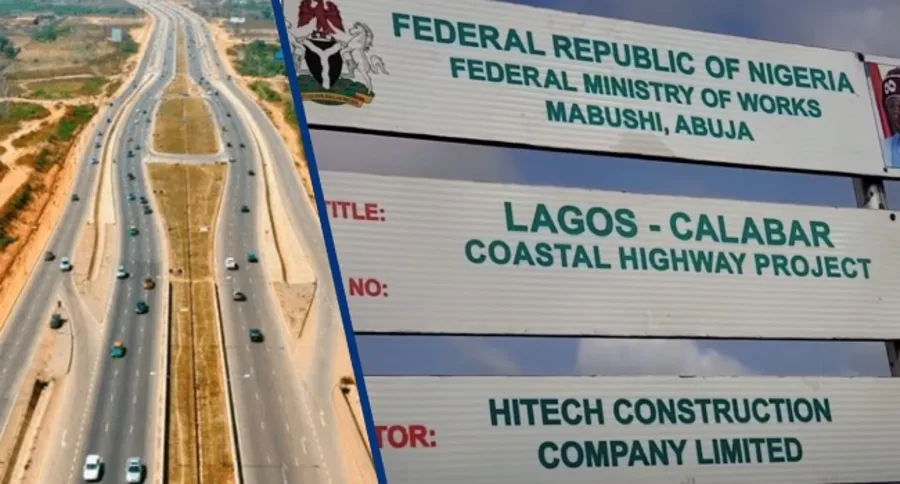
Lagos-Calabar coastal highway
He said the ministry consequently redesigned the route to avoid the difficult sections and had nearly completed filling work involving more than 10 metres of sharp sand.
“We had to take a very serious engineering decision by making a detour, redesigning it to avoid such a route. We are doing a filling of over 10 metres, which is 30 feet plus, with sharp sand, and filling is almost concluded,” the minister said.
The adjustment affects Sections 4A and 4B, covering 67 kilometres, including 27 kilometres in Ogun State and approximately 40 kilometres in Ondo State, with the route expected to terminate around the Ondo-Edo axis.
Progress across the project
The Lagos-Calabar Coastal Highway is a flagship infrastructure project of President Bola Tinubu’s administration, designed to connect Lagos with Calabar through several coastal states.
The first phase was commissioned by Tinubu in May 2025, while the Federal Government subsequently increased the project’s planned funding requirement from $700m to $747m.
Umahi said Section 1, a 47.47-kilometre stretch beginning at Victoria Island, Lagos, had been completed and was ready for commissioning.
He added that the dual pavement on Section 2, which spans 55 kilometres to the Lagos-Ogun boundary, was expected to be completed the following month.
The minister said redesign work had also been undertaken on flyovers, overpasses and underpasses around the Dangote Refinery and Lekki Deep Seaport to address traffic conflicts.
At the Calabar end, Sections 3A and 3B, covering 65 kilometres, had recorded more than 30 per cent completion, while construction continued on an 82-kilometre dual carriageway in Akwa Ibom State.
He also disclosed that work was progressing on an 88-kilometre link between Calabar and Ebidi Beach, intended to connect with the Trans-Saharan route.
Engineers question the original planning
Despite the government’s explanation, some engineering professionals have questioned whether sufficient feasibility studies and environmental assessments were conducted before construction began.
A former chairman of the Nigerian Society of Engineers, Ikeja branch, Akintayo Akintola, said the review should consider not only construction costs but also environmental consequences, drainage and accessibility for host communities.
He warned that an elevated highway or raised embankment could interfere with natural water movement if adequate drainage channels, culverts and other hydraulic structures were not incorporated into the design.
Akintola also questioned the proposed tolling arrangements, arguing that alternative routes should be considered to ensure commuters unable to afford toll charges retain practical transport options.
Another former chairman of the Nigerian Society of Engineers, Abeokuta branch, Abbas Mohammed, questioned whether preliminary studies and hydrological surveys had been carried out before the project commenced.
However, he said rerouting was a legitimate option if the original alignment proved unsuitable and the alternative could reduce costs while remaining technically viable.
Mohammed noted that major projects should be supported by comprehensive feasibility and geological investigations, while acknowledging that unforeseen construction challenges could emerge even after preliminary studies.
Support for the inland corridor
Transportation safety analyst Patrick Adenusi said moving the highway inland could reduce construction expenses, stimulate economic activity in towns and villages, and improve emergency response.
Although he said it was difficult to establish whether adequate feasibility studies had preceded the original route selection, he maintained that such assessments should ordinarily guide major infrastructure projects.
The debate over the diversion therefore centres on whether the revised alignment offers better value for money while meeting the highway’s transport objectives and protecting communities along its route.
The post Lagos-Calabar highway: When the original route hits a roadblock appeared first on WITHIN NIGERIA.
Follow the story
About this article
- Length
- 739 words · 4 min read
- Published
- October 18, 2026
- Byline
- JustAbdul
- Source
- Within Nigeria