

Mozambique Conflict Monitor (October Update)
Over August and September, Islamic State Mozambique (ISM) has increasingly targeted civilians in Mocímboa da Praia, Muidumbe, and Macomia districts

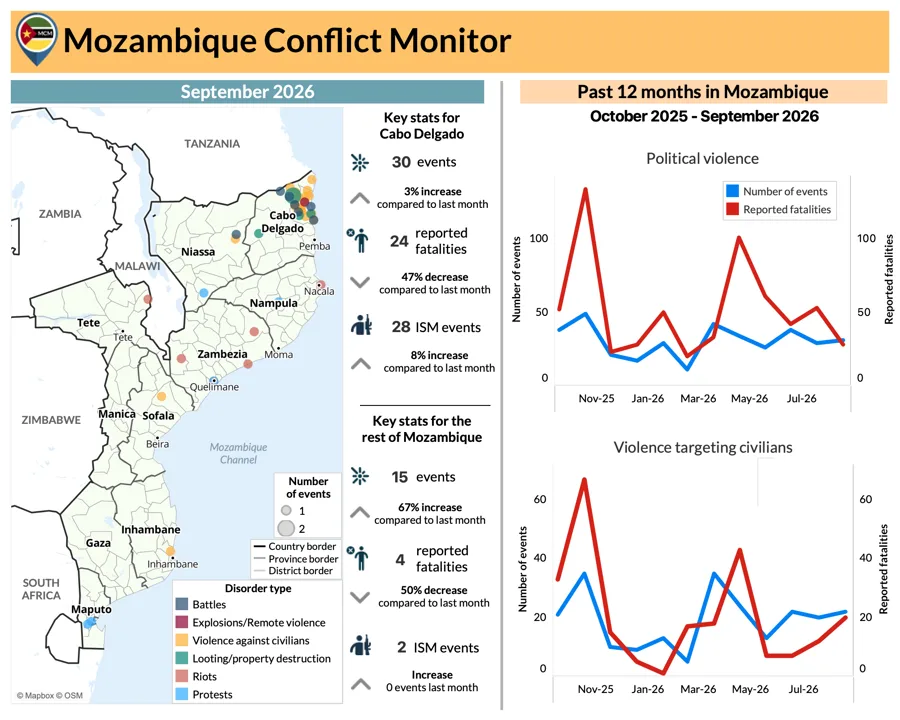
Overview
Over August and September, Islamic State Mozambique (ISM) has increasingly targeted civilians in Mocímboa da Praia, Muidumbe, and Macomia districts. In September, the group returned to threaten communities in Nangade. The response in Mocímboa da Praia town has been to tighten security measures, which has constrained commercial and humanitarian activity. As a result, the town is likely to become more tense. That tension may be directed toward the state, either through protests or increased collaboration with ISM.
Evidence suggests that ISM’s return to Nangade is to draw on support from neighboring Tanzania, a development likely to lead to tightened security measures on both sides of the border.
Meanwhile, the early October release of hostages taken by ISM in Niassa province last month in return for ransom is likely to embolden the group to target foreigners for abduction in the future. This will concern humanitarian organizations across Cabo Delgado, mining companies active around the Montepuez district, and Niassa province’s tourism sector.
Key developments
9 September | Six miners die in a mining pit collapse at the Seis Carros site in Manica province despite a moratorium on mining in the area, demonstrating the weakness of governance in the mining sector.
**14 September | **An Anamola party organizer is found dead after being kidnapped in Inhambane province. The victim was scheduled to appear as a defense witness in the trial of Anamola leader Venancio Mondlane, now postponed to 17 November.
15 September | Residents invade a Chinese-owned mining site in Zambezia’s Gile district, destroying equipment and assaulting a manager.
16 September | RENAMO member and former combatant Pensado Alfinete is shot dead at his residence in Inhaminga, Cheringoma district, Sofala province. RENAMO called for an investigation into the killing and warned that a lack of clarification could increase tensions among former combatants.
18 September | The International Monetary Fund concludes its Mozambique mission with no financing agreement in sight. Public investment will remain strained in the absence of a funding agreement with the IMF, which could unlock investment from donors and the private sector.
**30 September | **TotalEnergies is considering accelerated expansion of Mozambique LNG in the Palma district. With 10,000 workers on site, TotalEnergies’ commitment to the project ensures a continued international security presence in the province for some years to come.
ISM releases hostages in a Montepuez standoff
On 4 October, three hostages whom ISM had abducted during the 3 September raid on a hunting camp in Niassa were released. This was in return for a ransom of 3.2 million meticais (roughly $53,000 at the time), according to a local source. The three, a South African, a Zimbabwean, and a Mozambican, had been held since early September in the Shamba Kubwa mining area of Nairoto in the north of Montepuez district.
The release followed a standoff of over three weeks between ISM in the Shamba Kubwa area and the Defense Armed Forces of Mozambique (FADM) based in Ntola village, approximately 45 kilometers south.
FADM did not attempt an assault on Shamba Kubwa, likely due to the presence of hostages. ISM may have also deployed IEDs on approach to Shamba Kubwa from Ntola, according to a local source.
The group’s continued presence in the area suggests that they have a means of resupplying arms and ammunition. The group has likely developed a support network to facilitate this in Nairoto, having visited the area six months last year, and now three months in 2026. A local source also reports that the group has engaged in extortion at the mining site and also seized forestry equipment.
Their ability to resupply suggests that the group may consider staying in the area, rather than dispersing and returning to Macomia via the Meluco district, as past behavior suggests. This would stretch FADM’s capacity and present a continuing threat to civilians in Niassa, and tourism in particular.
Their ability to extract a significant ransom will likely encourage ISM in targeting high-value kidnap victims in the future, likely foreigners associated with businesses that have an international profile.
ISM’s increased civilian targeting supports multiple objectives
In September, ISM continued a trend of increasingly targeting civilians in Macomia, Mocímboa da Praia, Muidumbe, and Nangade districts, carrying out 19 attacks on civilians, up from 11 in August and nine in July. ISM targets civilians for three main purposes: to foment civilian displacement, generate income, and engage in retribution.
First, displacement can overwhelm civic and military authorities. Over August and September, attacks in Litandacua on the N380, and at Pangane on the coast, prompted over 700 people to flee, according to the International Organization for Migration. This creates opportunities for freedom of movement. September’s attacks on rural communities in Nangade are likely to have provided cover for ISM to maintain a connection to support networks in Tanzania for recruits and supplies. On 20 September, Tanzanian troops stationed in Nangade killed two suspected insurgents who had crossed from Tanzania, and arrested a third. A group of ISM fighters was later seen making its way to the Namatil area of Nangade, likely to receive the group intercepted by the Tanzanian military or others.
Second, income can be generated from ransom. Eleven attacks on civilian communities involved abductions, and ransoms were reported in five incidents, ranging from 1,500 to 70,000 meticais.
The third reason is retribution. ISM carried out at least three attacks in September on civilians on Macomia’s coast, an area in which ISM has established an area of influence, and in which attacks on civilians are rare. These act as a warning to communities suspected of collaborating with FADM and the Rwanda Defence Force, which have been conducting sporadic operations against ISM in Quiterajo, about 35 km to the north, including marine operations.
In the coming weeks, there is a risk that such actions will escalate in Cabo Delgado’s southern districts. In late September, ISM fighters in Quissanga were seen moving south toward the Ancuabe district. As in districts to the north, the group will pose a significant threat to isolated rural communities and artisanal and small-scale mining sites, and less so to commercial gemstone mining projects.
Security tightened in Mocímboa da Praia town
In September, ISM carried out attacks to the south, north, and west of Mocímboa da Praia town (see map below), in ways that continue to restrict humanitarian and commercial access to the town and allow ISM to maintain supply networks there. These attacks come as heightened security measures in September have raised tensions in the town, according to local sources.
With the airport closed and the N380 at risk, humanitarian access to the town is via Palma to the north. However, ISM attacks on the R762 illustrate the heightened risk faced on that route. Attacks to the west, likely carried out by a group operating from the Nkonga area of neighboring Nangade district, maintain pressure on the N380 and force rural communities back to Mocímboa da Praia town.
To the south, Islamic State media claimed that ISM successfully deployed an IED against an RDF patrol on the road linking Chinda village on the N380 to an RDF base at Mbau village, 30 km southwest of Mocímboa da Praia town, on 16 September. The combination of a poor road running through heavily forested land makes the road susceptible to such attacks, hindering state forces’ movement and allowing ISM to maintain its presence in the area.
Authorities in the town are concerned that ISM’s nearby presence allows suppliers operating in the town to easily reach ISM forces to supply them with cash, food, and other necessities. Authorities have responded to ISM activities in the area by restricting access from the town to surrounding areas and establishing checkpoints to prevent movement in or out of the town after 15:00, according to a source in the town. Within the town, there is a heightened security presence. FADM permanently guards the Administrator’s office, and the State Security and Intelligence Service has increased its presence, according to a local source. If the situation persists, straitened humanitarian services and commercial activity will lead to worsening conditions in the town, risking community unrest.
Follow the story
About this article
- Length
- 1,352 words · 7 min read
- Published
- October 6, 2026
- Byline
- Zitamar News
- Source
- Zitamar News