

How new elephant collars at Kasungu National Park wire up wildlife corridor and conservation
EMPLOYING WILD-TECH FOR DATA—Veterinary technicians fitting new GPS collars to 20 tranquillised elephants at Kasungu National Park, Malawi By Charles Mpaka: In a 2,300-square kilometre landscape of expansive miombo forest, split in parts by rivers, fragmented in some by stretches of dambos and rising in others to hills jutting above tree canopy, how do wildlife authorities successfully keep an eye on species that can sometimes travel as much as 200 kilometres in one day? In Kasungu National Park

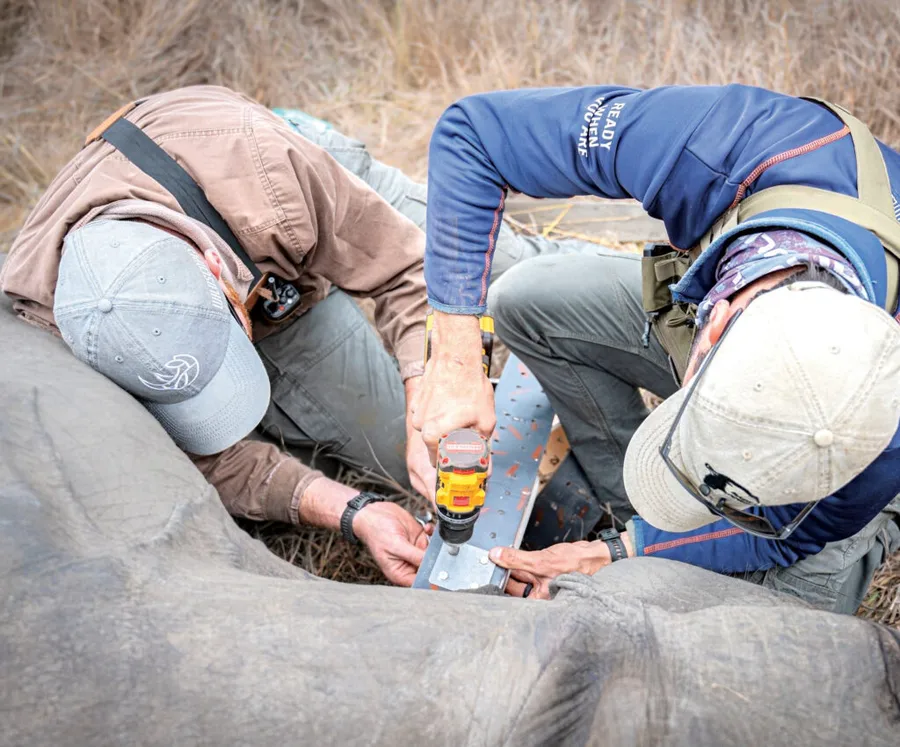
EMPLOYING WILD-TECH FOR DATA—Veterinary technicians fitting new GPS collars to 20 tranquillised elephants at Kasungu National Park, Malawi
By Charles Mpaka:
In a 2,300-square kilometre landscape of expansive miombo forest, split in parts by rivers, fragmented in some by stretches of dambos and rising in others to hills jutting above tree canopy, how do wildlife authorities successfully keep an eye on species that can sometimes travel as much as 200 kilometres in one day?
In Kasungu National Park, elephants – now estimated at more than 400 as their population surges from the historical decline of the mid-1990s – are roaming its breadth and length, engineering the ecosystem with their voracious foraging and enabling conditions for other wildlife to thrive.
From the days when it was ransacked to nearly insects and shrubs only, this Malawi’s second largest national park is flourishing towards its glorious past, thanks to a decade of restoration efforts led by the Department of National Parks and Wildlife (DNPW).
The steadily rising elephant population is one symbol of the park’s resurgence.
But if there has to be enhanced protection of these wandering jumbo herds, if there has to be improved co-existence between the increasing elephant population and the humans in the villages surrounding the park, employing advanced monitoring techniques of the species can be critical.
So, when the DNPW, with funding and technical support from the International Fund for Animal Welfare (Ifaw), a global non-profit, fitted new tracking collars to 20 elephants in Kasungu National Park last week, wildlife protection authorities and research community had a scientific aid for more reliable and more detailed data for more robust and impactful conservation strategies.
“Tracking data helps DNPW monitor the elephants around the clock, providing conservationists with the information needed to support the long-term management and conservation of Kasungu National Park and the surrounding community areas,” said Bruce Sosola, Ifaw Director for Malawi, in a statement about the operation.
Over the next four or five years, which is the recorded lifespan of the battery of the GPS-enabled collars, wildlife rangers and scientists will be able to have at their fingertips realtime information that would prove vital to conservation decision-making.
According to wildlife technology scientists, the data collected through the collars helps in tracking elephant migration routes and understanding their health and behaviour such as feeding habits. The data also provides alerts of potential conflict with communities.
The DNPW has long been converted to wild-tech, previously crediting it with Malawi’s successes against illegal wildlife trade.
“We have seen how useful technology is in management of wildlife,” DNPW Director, Brighton Kumchedwa, told this paper.
“Our vision therefore is to have all protected areas run on high technology as this is the only way we can deal with this wildlife crime, which is highly resourced and
highly organised,” Kumchedwa said then.
This vision was supported by a number of tech-driven crime-busting cases, one of which occurred in 2017. That time, two poachers from Ntaja in Machinga District had invaded Liwonde National Park where they killed a rhino whose horn was fitted with a chip with a Very High Frequency transmitter.
One of the poachers hid the horn in his house at Ntaja, ahead of a sale, unaware that the chip was emitting signals to a monitoring team at the park, which led to the tracking and subsequent arrest of the poachers.
EMPLOYING WILD-TECH FOR DATA—Veterinary technicians fitting new GPS collars to 20 tranquillised elephants at Kasungu National Park, Malawi
They were jailed for 18 years – a punishment that sent a blunt warning to would-be poachers.
Over the past two decades, regional and global conservation organisations have supported the DNPW in investing in wildlife technology applications that are strengthening Malawi’s conservation capacity through collection of realtime data that helps in poacher detection interventions and control of animal movements to reduce human-wildlife conflict – the very objectives of the recent elephant collaring at Kasungu National Park.
This recent operation further fits into a grander conservation strategy for the Malawi-Zambia landscape, as Sosola said in the statement.
“The exercise is part of an ecological monitoring operation aimed at improving understanding of elephant movements across the landscape and supports Ifaw’s Room to Roam approach of protecting and connecting the habitats elephants need to move safely and thrive,” he said.
According to Ifaw, the Room to Roam strategy is informed by more than two decades of critical research about the behaviour and movement patterns of elephants and wildlife in general. The approach seeks to reestablish the ecological corridor that once existed between Kasungu National Park and Lukusuzi National Park in Zambia’s Eastern province.
Regionally, this Malawi- Zambia landscape is a Sadc-designated Tranfrontier Conservation Area (TFCA), lying south of the 32,000-square-kilometre transboundary conservation territory between Malawi and Zambia, interspersed with miombo woodlands and boasting several national parks, forest reserves, game management areas and communal lands.
In a policy brief, Sadc says conservation corridors such as the one between Lukusuzi and Kasungu national parks increase opportunities for investment in income generating activities such as eco-tourism and sustainable farming practices for communities.
“TFCAs often seek to establish a complementary network of formal and informal protected areas across the landscape, linked through corridors which ensure the continued existence of migratory wildlife species which are otherwise becoming increasingly isolated due to habitat loss and fragmentation,” Sadc says.
Ifaw says for elephants and other wildlife populations and people to thrive together in future against the various threats including climate change, there is need to maintain a network of connected ecosystems.
This is informed by, among others, the fact that wildlife knows no geographical boundaries. In proof of this, in July 2026, four wild dogs appeared in Kasungu National Park, the first time the species had been spotted in the park in more than 10 years. When scientists from the Zambia Carnivore Programme identified them, it emerged that the pack had travelled from Zambia’s South Luangwa Valley, some 140km away from Kasungu National Park.
The simple logic of the Room to Roam approach is this – that nature created ecosystems interconnected to each other, that opening what shut them from each other allows wildlife species to regain their natural freedom to move to find food and water and mates.
Ensuring functionality of these ecological corridors while also enabling sustainability of the livelihoods of humans living in that space is achievable through understanding movement of some of the species, their migration routes, their feeding patterns, their behaviour, their numbers – data that would then guide measures for their effective control.
Last week’s elephant collaring serves this purpose.
Follow the story
About this article
- Length
- 1,092 words · 5 min read
- Published
- October 17, 2026
- Byline
- Times News
- Source
- The Times Group