

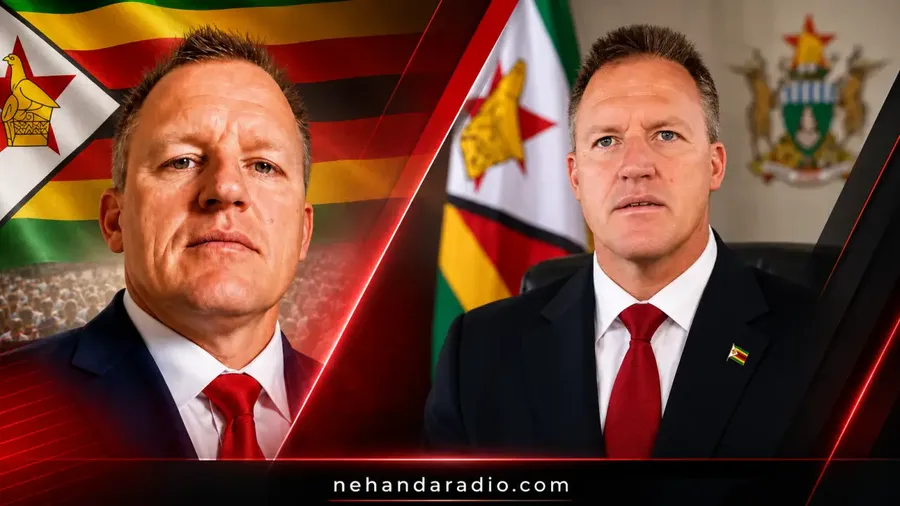
Brett Muvheti: Zimbabwe’s next president, or just another internet sensation?
Brett “Muvheti” Holley has ambitions to transform Varanda VeZimbabwe from an online political movement into a force capable of challenging for power. Gabriel Manyati asks whether he is building something consequential—or whether social-media popularity is being mistaken for political power. The post Brett Muvheti: Zimbabwe’s next president, or just another internet sensation? appeared first on Nehanda Radio .

AI summary
In Zimbabwean politics, going viral can be the beginning of something extraordinary. It can also be the beginning of the end.
Evan Mawarire discovered the first possibility in April 2016, when he sat in front of a camera with the Zimbabwean flag draped around his neck and recorded an anguished four-minute reflection on what his country had become.
He was a pastor, not a politician. He had no party, no parliamentary seat and no obvious machinery behind him. Yet the video travelled rapidly across the internet and became the seed of #ThisFlag, one of the most remarkable citizen movements Zimbabwe had seen in years.
Brett Holley, better known online as Brett “Muvheti”, is now testing a different version of the same political proposition. The Zimbabwean businessman and political commentator has launched Varanda VeZimbabwe, or VVZ, meaning “Servants of Zimbabwe”.
He is not merely proposing another opposition party. He has spoken of establishing a government-in-exile from the diaspora and ultimately taking political power through a popular revolution based on mobilisation rather than armed struggle.
That ambition is easy to ridicule. It would be more dangerous to dismiss it.
The question is not whether Muvheti is already a credible presidential contender. There is simply not enough evidence to make that case. The more interesting question is whether he is building something that could become consequential when Zimbabwe’s political equilibrium next comes under serious strain.
Zimbabwe Has Seen This Movie Before
The comparison with Mawarire is unavoidable, but it should also be handled carefully.
Mawarire’s extraordinary rise demonstrated both the power and the limitations of digital politics. His #ThisFlag campaign turned a personal expression of frustration into a national conversation about corruption, poverty and political accountability.
On 6 July 2016, the movement called a nationwide stay-away that shut businesses and schools and demonstrated that an online audience could, under the right circumstances, be converted into physical action.
There was even a wonderfully Zimbabwean moment of political comedy in the middle of it. Jonathan Moyo, then one of Mugabe’s most combative ministers, dismissed #ThisFlag as a “pastor’s fart in the corridors of power”.
The insult was intended to make Mawarire look ridiculous. Instead, it became evidence that the government was paying close attention to a movement it claimed was insignificant.
That episode contains a useful lesson for assessing Muvheti. Political establishments often laugh at unfamiliar forms of dissent until they realise that the joke has stopped being funny.
But Mawarire’s story also supplies the warning. #ThisFlag became a formidable civic movement, but it did not transform its founder into Zimbabwe’s president.
Mawarire later faced arrest, threats and exile, and the movement’s energy flowed into a broader ecosystem of protests and opposition activism rather than becoming a durable governing organisation under his personal command.
Muvheti therefore faces a paradox. Mawarire proved that a Zimbabwean with a phone can ignite a political fire. He did not prove that the person holding the phone can necessarily govern the country.
The Man Behind The Persona
Holley’s political identity has grown largely through direct communication with Zimbabweans online. He is a businessman and social-media personality who developed a following through political commentary before moving towards organised activism.
He has described VVZ as a project built around servant leadership and the idea that politicians should answer to citizens rather than behave as their masters.
The distinction between Holley and Muvheti matters. Holley is the man. Muvheti is the political persona. VVZ is the test of whether that persona can become an institution.
So far, the evidence is strongest for the first two and weakest for the third.
That is not an insult. Every political organisation begins somewhere. The difficulty is that Zimbabwe is a particularly unforgiving laboratory in which to discover whether an internet following can become a political machine.
The Vacancy Muvheti Sees
His timing is not irrational.
Zimbabwe’s opposition has emerged from the wreckage of the Citizens Coalition for Change far weaker and more fragmented than it entered the 2023 election.
Nelson Chamisa demonstrated that a powerful opposition constituency exists, but the subsequent disintegration of his political vehicle has left millions of voters without an obvious alternative around which to organise.
According to official election results announced by the Zimbabwe Electoral Commission, ZANU PF won 175 of the 280 National Assembly seats in 2023, compared with 104 for the CCC.
In the Senate, ZANU PF secured 33 of the 60 elected seats against 27 for the CCC. Chamisa received 1 967 343 presidential votes against President Emmerson Mnangagwa’s 2 350 711, a difference of 383 368 votes.
Chamisa and the CCC rejected the result, while international and domestic observers raised serious concerns about the conduct of the election.
The important point is not that Chamisa almost won. It is that nearly two million Zimbabweans voted for an opposition presidential candidate despite the extraordinary structural advantages of the ruling party.
That constituency did not disappear. But neither did it automatically become available to whoever could speak most persuasively into a smartphone.
The constitutional environment has also changed. Amendment No. 3, signed into law in July 2026, extended presidential and parliamentary terms from five to seven years and replaced direct presidential election with a system in which the president is elected by a joint sitting of parliament. The next general election is consequently expected in 2030.
Muvheti is therefore entering a political system that is simultaneously frustrated, fragmented and institutionally more difficult to challenge.
The Seduction Of The Outsider
However, there is a powerful case for taking him seriously.
Outsiders have one enormous political asset: they have not yet accumulated the disappointments associated with incumbency or opposition failure.
Muvheti can present himself as untainted by the factional battles, broken promises and leadership disputes that have consumed much of Zimbabwean opposition politics.
His language is direct. His political persona is unconventional. His diaspora connections could potentially give VVZ access to money, professional expertise and international networks.
And social media has changed the old rules.
A politician no longer needs a newspaper, a television station or a national network of party offices to reach hundreds of thousands of people. A phone can become a broadcasting station. A personality can become a political brand before an organisation exists.
This is precisely why the Mawarire comparison matters. In 2016, #ThisFlag demonstrated that online political communication could become grounded mobilisation when the message struck a sufficiently deep public grievance.
Muvheti could, in theory, attempt the same leap. But the internet is exceptionally good at creating the sensation that everyone is in the room.
Politics begins when the room becomes a country.
Attention Is Not Power
This is where the Muvheti experiment encounters the hard mathematics of political power.
The equation is not complicated, although satisfying it is brutally difficult: popularity + organisation + money + legitimacy + institutional access + voter mobilisation + political opportunity.
Popularity is the most visible ingredient, and therefore the easiest to mistake for the whole recipe.
VVZ may have growing visibility, but there is no reliable public polling establishing the size of Holley’s electoral constituency. Nor is there yet convincing evidence of a nationwide organisation capable of operating from provincial headquarters down to wards and villages.
Money presents a similar ambiguity. Diaspora support can finance communications, travel and organisation, but money outside Zimbabwe does not automatically become votes inside Zimbabwe.
Legitimacy is another matter. Holley can argue that his legitimacy will come from ordinary Zimbabweans, but political legitimacy becomes substantially harder to dispute when it survives the tests of organisation, representation and elections.
Institutional access appears even more limited. ZANU PF operates through a political ecosystem extending into parliament, local government, traditional structures and state institutions. VVZ has yet to demonstrate comparable reach.
Then comes voter mobilisation. Can people who enthusiastically share a video also register, attend meetings, recruit neighbours, contribute money, campaign under pressure and actually turn out to vote?
That is the difference between an audience and a movement.
Holley has Facebook. That is not nothing. But it is not enough.
The Government-In-Exile Gamble
The government-in-exile proposal is where Muvheti’s politics become genuinely unconventional.
Media reports say Holley’s plan to establish a government-in-exile outside Zimbabwe, while other Zimbabwean outlets have reported his ambitions for VVZ to become a vehicle for political transformation.
The idea should neither be mocked nor romanticised.
Historically, governments-in-exile have generally derived their authority from circumstances in which an existing government was displaced from its territory, often through war or occupation, while retaining some measure of international recognition.
An opposition movement establishing itself abroad does not automatically inherit that legitimacy.
Holley appears to treat recognition as something that can follow popular legitimacy rather than precede it. That is a bold proposition, but it leaves a difficult practical question unanswered: who inside Zimbabwe would obey a government that does not control Zimbabwe?
A diaspora movement can raise money, lobby foreign governments, coordinate activists and create an alternative political narrative. It cannot, by declaration alone, administer schools in Bulawayo, collect taxes in Harare or command the police in Mutare.
For the government-in-exile idea to become more than political theatre, something dramatic would have to happen inside Zimbabwe.
When Political Systems Crack
That is why Holley’s prospects cannot be judged only by looking at the country as it exists today.
Zimbabwe’s history contains a lesson about political rupture. In November 2017, Robert Mugabe had ruled for 37 years. Yet within days of a military intervention, an internal ZANU PF revolt, mass demonstrations and parliamentary pressure, his political order had collapsed.
The lesson is not that another 2017 is inevitable. It is that apparently permanent political arrangements can sometimes change with astonishing speed once the forces holding them together begin pulling in different directions.
That is where a movement such as VVZ could become unexpectedly relevant.
Imagine an outsider who has spent years building diaspora networks, recruiting organisers and establishing a national political identity when a succession crisis, economic shock, disputed transition or major fracture within the ruling establishment suddenly opens political space.
The outsider does not need to have been the country’s favourite politician the day before the rupture. He needs to have built something capable of filling the space afterwards.
That is a much more interesting proposition than asking whether Muvheti can defeat ZANU PF tomorrow.
The Obstacles Nobody Should Ignore
There are also less dramatic ways in which VVZ could fail.
The movement could remain predominantly online, becoming influential in political conversation without becoming electorally consequential. Holley could discover that diaspora enthusiasm is not replicated among voters facing the mundane realities of food prices, transport, school fees, farming and employment.
He could also encounter co-optation. Political establishments rarely respond to challengers with only repression. They can offer access, positions, business opportunities or political accommodation to influential figures and thereby drain a movement of momentum.
Then there is containment. A diaspora-based political project could face legal proceedings, financial restrictions, travel complications or other forms of pressure that make organisation increasingly difficult.
And there is the oldest problem of all: personality.
Mawarire’s experience provides a warning here. A charismatic founder can be the movement’s greatest asset while simultaneously becoming its greatest vulnerability.
Once supporters begin to equate a political cause with one individual, criticism of the individual can become indistinguishable from criticism of the cause.
If VVZ becomes inseparable from Holley, then the movement risks reproducing precisely the leader-centred politics it claims to challenge.
What Would Make Him Dangerous To Ignore?
Five things would change the calculation.
VVZ would need functioning structures throughout Zimbabwe, not merely enthusiastic online supporters. It would need to demonstrate measurable support beyond social media. It would need credible political, civic, business and community figures capable of building an organisation larger than one personality.
It would need a serious governing programme. Zimbabweans can be angry with ZANU PF and still ask a perfectly reasonable question: what happens on Monday morning if you win?
And finally, Holley would need to demonstrate resilience. Can VVZ survive internal disagreement, government pressure, criticism, financial strain and the inevitable temptations that accompany political success?
Until it answers those questions, Muvheti remains a political possibility rather than a presidential contender.
The Verdict
So, can Brett Holley take power in Zimbabwe?
Not on the evidence available today.
He lacks the electoral record, nationwide machinery and institutional reach that Nelson Chamisa possessed in 2023. He faces a ruling party whose organisational depth cannot be replicated by accumulating followers online. There is no credible polling showing that Zimbabweans are preparing to hand him the presidency.
But dismissing him would be a mistake for a different reason.
Zimbabwe has already shown what happens when an apparently insignificant digital voice touches a deep national nerve. Mawarire’s flag became more than a piece of cloth.
It became a way for frightened citizens to recognise that their private frustrations were shared by millions of others. The movement did not put Mawarire into State House, but it changed the political atmosphere and helped enhance a wider culture of resistance.
Muvheti is attempting something more ambitious. He is not simply asking Zimbabweans to speak. He is asking them to organise around a new political vehicle and, eventually, to transfer state power.
That is a much higher mountain.
Political opportunities rarely announce themselves politely. They arrive through crises, fractures, scandals, succession battles and moments when citizens suddenly stop believing that yesterday’s political arrangements must govern tomorrow.
Muvheti’s real challenge is therefore not to prove that he can win Zimbabwe today. It is to build a movement capable of surviving long enough to discover what becomes possible when today’s political certainties begin to dissolve.
Zimbabwe may not be ready for Brett Muvheti.
But politics is not ultimately a contest between those who are ready and those who are not. It is a contest over who is prepared when history suddenly changes the question.
Follow the story
About this article
- Length
- 2,302 words · 12 min read
- Published
- September 2, 2026
- Byline
- Gabriel Manyati
- Source
- Nehanda Radio