

Weak incomes make home ownership unattainable… slow serviced land delivery compounds housing backlog

AI summary
The dream of decent homeownership is becoming increasingly unattainable for many ordinary households in Namibia, as weak incomes and an inadequate supply of serviced land are widening the gap between what homes cost and what most Namibians can afford.
This is the conclusion of a housing affordability analysis by the financial services firm Simonis Storm (SS) Research, which warns that the local housing crisis is not simply a problem of expensive houses but a structural failure involving incomes, land delivery, construction costs, financing and the type of housing supplied.
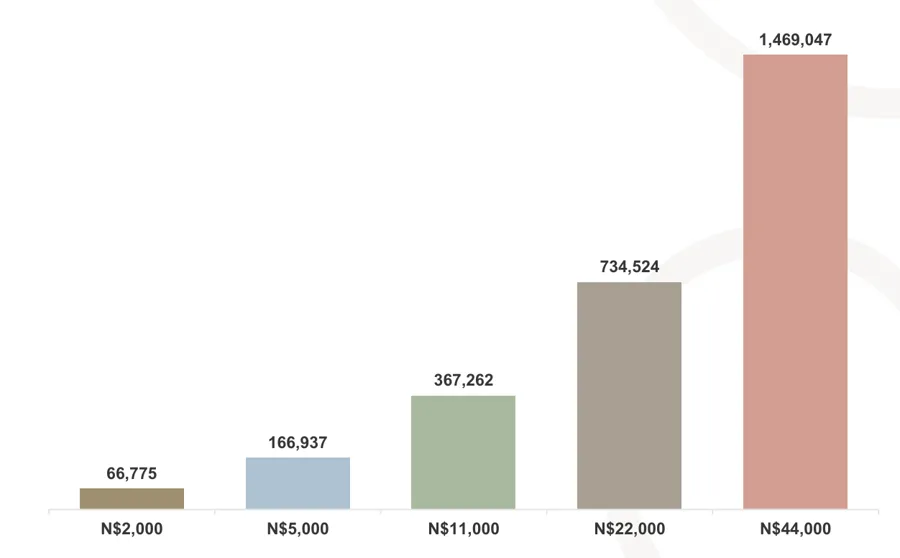
The scale of the affordability problem is particularly troubling. The report, titled “Priced Out: Namibia’s Housing Affordability Trap”, estimates that a gross monthly income of over N$43 000 is required to afford the national average house price of N$1.46 million. This is under illustrative mortgage assumptions involving a 10% deposit, a 20-year repayment period, a 10.5% interest rate and repayments capped at 30% of gross income.
An income level of over N$43 000 is far removed from the earnings of most Namibians. According to the SS report’s provisional interpretation of the 2025 Namibia Financial Inclusion Survey, 54.1% of adults reported personal monthly income of N$2 000 or less. Simonis Storm cautioned that while underlying income tables have not yet been independently verified and that discrepancies exist in publicly reported figures, the available data nevertheless points to a profoundly weak income base.
At the same time, local house prices continue to rise. The FNB House Price Index recorded a 7.4% year-on-year increase in the national average house price in the second quarter of 2026, taking the average to well over N$1.4 million. Central, coastal and northern markets recorded particularly strong increases, with regional growth reaching as high as 11.9%. The result is a housing market increasingly disconnected from the financial reality of most Namibians.
The problem is compounded by the slow delivery of serviced land. Government’s strategic target is to deliver 10 000 serviced plots annually through 2029/30, yet the most recent reported figures show only slightly over 1 700 plots fully serviced, alongside 1 064 partially serviced plots. Fully serviced delivery therefore amounted to only about 18% of the annual target during that reporting period.
The SS report identified weak and insecure household incomes and the slow serviced-land pipeline as the two “binding constraints” on affordability, with construction costs, financing conditions, tenure insecurity and an unsuitable housing-product mix worsening the The SS report also exposes how poorly the conventional mortgage model fits the way most Namibians actually obtain housing. Only about 7% of owner households reported using a bank loan to buy or build, while 64% said they built their dwelling rather than bought it. This suggests that policies centred primarily on conventional mortgage-financed homeownership are failing to address the realities of the majority.
Meanwhile, Namibia faces a housing backlog estimated by the National Housing Enterprise at around 300 000 units, with Simonis Storm putting the associated requirement at approximately N$76 billion. Against this, only N$1.5 billion was identified in the 2026/27 budget, leaving an enormous funding gap.
The consequences are already visible in informal settlements. Namibia’s first Informal Settlements Baseline Report assessed 563 urban settlements across 57 local authorities and classified 419 as informal, covering more than 200 000 residents in the settlements assessed.
SS argues that simply imposing broad house-price or rent controls will not solve the underlying problem. Instead, the report calls for a predictable serviced-land pipeline, a broader range of affordable housing products, including serviced sites, starter units and incremental self-build options, as well as reforms capable of raising incomes and improving the business environment.
The central warning from SS is blunt, namely that “Broad price controls cannot substitute for reforms that expand land supply, incomes and suitable housing products.”
Domestically, the housing crisis is therefore increasingly an economic crisis. Until wages, land delivery and housing supply move closer to the realities of ordinary households, decent housing will remain a privilege for a relatively small formal-market segment rather than an attainable asset for the majority.
The post Weak incomes make home ownership unattainable… slow serviced land delivery compounds housing backlog appeared first on New Era.
Follow the story
About this article
- Length
- 691 words · 3 min read
- Published
- September 2, 2026
- Byline
- Edgar Brandt
- Source
- New Era Namibia