

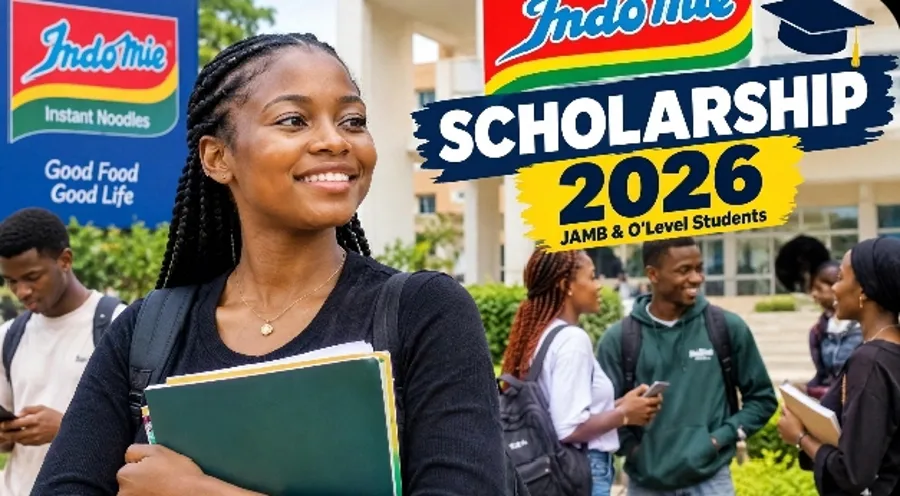
Indomie Scholarship 2026 requirements, deadline and application guide for Students with JAMB and O’Level Results

AI summary
For thousands of Nigerian students preparing to begin tertiary education for the 2026/2027 academic session, the next few days could determine whether a major part of their school expenses receives support. The Indomie Scholarship Programme 2026 is already attracting attention because it is designed around tuition support for newly admitted students, but several details surrounding the application are easy to miss, especially for applicants who have been relying on older scholarship listings found online. The deadline currently displayed on the official Indomie scholarship page is September 30, 2026, while some older listings still carry August 31, 2026, making it important for prospective applicants to work with the latest information before submitting their details.
The programme also comes with requirements that immediately narrow down the group of students who can benefit from it. It is not presented as a general cash giveaway for every Nigerian student, and it is not designed only for university undergraduates. The current information covers newly admitted Nigerian students entering eligible public or state owned tertiary institutions, including universities, polytechnics, colleges of education and specialised institutions. There are also details concerning JAMB results, WAEC or NECO results, application completion, CBT, physical verification and annual renewal that applicants need to understand before assuming that filling the form automatically guarantees the scholarship.
Indomie Scholarship Programme 2026
The Indomie Scholarship Programme 2026 is an education support initiative associated with Dufil Prima Foods Plc, the Nigerian company behind Indomie. The programme is targeted at Nigerian students who are entering tertiary education for the 2026/2027 academic session, with the stated benefit focused on full tuition coverage for the duration of the eligible programme. The tuition support is also described as renewable annually, provided the beneficiary maintains the required academic performance. This makes the opportunity different from a scholarship that simply gives successful applicants a single cash payment and leaves them to handle their school fees independently.
The current programme information places the emphasis on tuition rather than a fixed amount of money. There is no universal naira figure publicly stated on the current programme page that every successful student will receive. The value of the scholarship therefore depends on the tuition associated with the eligible programme and institution. This distinction matters because students searching online may encounter descriptions that present the opportunity as a cash award or as a fully funded package covering every aspect of student life, while the clearest official description focuses specifically on full tuition.
Dufil Prima Foods has also supported education related initiatives in Nigeria through other programmes, but those initiatives should not automatically be merged with the 2026 Indomie Scholarship Programme. The scholarship currently being discussed has its own eligibility conditions, application route and selection process. Applicants should therefore focus on the requirements attached to the 2026 programme rather than combining details from older Dufil education projects or separate scholarship schemes.
Scholarship Benefit
The central benefit attached to the 2026 programme is full tuition coverage for the duration of the eligible programme. This means the scholarship is structured to address tuition fees rather than simply placing a fixed amount of money into the student’s account. Annual continuation is also tied to academic performance, meaning beneficiaries are expected to maintain the required GPA or academic standard for the scholarship to continue from one year to another.
The current public information does not provide a single fixed naira value that applies to every beneficiary. A student entering a 4 year university programme, for example, could have a different total tuition requirement from another student entering a different programme or institution. Publishing a specific amount as though every recipient receives the same cash value would therefore create an impression that is not supported by the current programme information.
Applicants should also pay attention to the difference between full tuition and full living support. The current information does not clearly state that the programme pays for accommodation, feeding, transportation, textbooks, laptops, data, personal expenses or monthly allowances. Students should therefore plan for these expenses separately unless further official information is released confirming additional benefits.
Eligibility Requirements
The first major requirement is Nigerian citizenship. The programme is intended for Nigerian students entering tertiary education during the 2026/2027 academic session. Applicants should therefore ensure that their personal information accurately reflects their Nigerian status before proceeding with the application.
Another major requirement concerns admission status. The scholarship is directed at new entrants into tertiary education for the 2026/2027 academic session. This means an applicant who is already several years into a tertiary programme should not assume that the scholarship is available simply because the applicant is still paying tuition. The current wording specifically focuses on students entering tertiary education during the stated academic session.
The institution also matters. The current eligibility information refers to public or state owned institutions, meaning students admitted into private institutions should not treat the programme as automatically applicable to them. Eligible institution categories mentioned by the programme include universities, polytechnics, colleges of education and specialised institutions, provided they fall within the stated public or state owned category.
Course of study is not presented as a narrow restriction on the current programme page. The scholarship information indicates that eligible courses across the listed institution categories can be considered. This means the opportunity is not described as being restricted only to science, technology, engineering or mathematics courses. Students in fields such as Economics, Education, Accounting, Engineering, Medicine, Computer Science and other eligible programmes can therefore examine the scholarship based on their institution and admission status.
JAMB Result Requirement
JAMB information forms part of the application requirements for the scholarship. Applicants should have their JAMB result available because the programme is designed around students entering tertiary education, making admission related information an important part of the application process.
One useful feature of the current application process is that applicants do not necessarily have to upload every result before starting the application. The official information indicates that applicants can begin with their personal details and passport photograph before completing the academic result section.
This means students who are preparing their documents should not assume that they must wait until every document is immediately available before opening the application. The important point is that outstanding information must be completed before the application deadline. Applicants should therefore avoid treating the ability to begin the process without results as permission to leave the application incomplete after September 30, 2026.
O’Level Result Requirement
WAEC and NECO results are also supported by the application process. The current FAQ indicates that applicants can use up to 2 sittings, with results from WAEC and NECO accommodated within the application process. This provides room for applicants who obtained the required results across more than 1 examination sitting.
Applicants should enter their actual grades carefully and ensure that the information submitted matches their official results. The availability of 2 sittings should not be interpreted as an automatic guarantee of eligibility because the applicant must still satisfy the wider requirements of the scholarship programme.
Students who have both WAEC and NECO results should therefore keep their result information accessible while completing the application. Accuracy is particularly important because the scholarship process continues beyond the initial form, with shortlisted candidates expected to go through further stages before final selection.
Eligible Institutions
The range of institutions covered by the programme is broader than universities alone. The current information specifically mentions public or state owned universities, polytechnics, colleges of education and specialised institutions. This makes it relevant to newly admitted students whose tertiary education route does not involve a conventional university degree.
A student admitted into a public university can examine the opportunity, while a newly admitted student in an eligible public polytechnic or college of education can also check the requirements. The same principle applies to eligible specialised institutions covered by the programme information.
Students admitted into private institutions should pay particular attention to the wording before submitting an application based on assumptions. The current eligibility information refers to public or state owned institutions, so private institution admission should not be treated as qualifying without a specific official update.
Application Process
The first stage is to visit the official Indomie Scholarship Programme page and use the application route provided there. Applicants should avoid relying on registration links circulated through unofficial social media posts when the official programme page is available, especially because scholarship scams can imitate legitimate opportunities and request money from applicants.
New applicants are directed to select the appropriate registration option and begin entering their personal information. The information requested includes the applicant’s full name, email address, phone number, date of birth, state of origin and passport photograph. Applicants should use active contact information because later communication concerning the selection process can depend on the details supplied during registration.
The application process allows applicants to begin before all academic results have been uploaded. Students can start with the personal information section and subsequently upload their JAMB and O’Level results before the deadline. This gives applicants an opportunity to create their application early rather than waiting until every document is gathered before beginning the process.
Applicants should also verify the information supplied during registration. The programme information refers to verification through email or phone details before submission. A student who enters an incorrect phone number or email address could create unnecessary difficulty when trying to receive later communication, so the details should be checked carefully before the application is completed.
Application Deadline
The current official deadline is September 30, 2026. This date is particularly important because older scholarship listings continue to display August 31, 2026, which was associated with the earlier deadline for the programme.
The difference between the 2 dates has created the possibility of confusion for applicants searching through older opportunity websites. Someone who relies only on an older article could incorrectly conclude that the programme has already closed. The current Indomie scholarship page, however, displays September 30, 2026 as the current deadline.
As of September 25, 2026, applicants therefore have only a few days remaining before the current deadline. Anyone who intends to apply should work from the live official programme information and complete outstanding sections before September 30, 2026 rather than relying on an older August 31 date.
Applicants should also remember that starting an application is not the same as completing it. Since the programme allows applicants to begin before uploading their JAMB and O’Level results, students should ensure that all required information has been submitted before the stated deadline.
Application Fee
The Indomie Scholarship Programme application is free. Applicants should not be required to pay a registration charge simply to submit the scholarship application through the official route.
Students should be careful when dealing with anyone who claims to have access to guaranteed selection, special registration, paid shortlisting or paid CBT arrangements. The official application information does not present the scholarship as a programme where applicants must pay for registration.
The same caution applies to requests for money in exchange for supposedly securing a scholarship place. A genuine applicant should use the official application route and follow the published process rather than transferring money to an individual claiming to represent the programme.
Selection Process
Submitting an application does not automatically mean that a student has been selected. The programme has a defined selection process that moves beyond the initial application stage.
The published sequence is application, shortlisting, CBT, physical verification and final selection. This means applications are reviewed before eligible candidates are invited to the next stage. Shortlisted candidates are then expected to receive information concerning the CBT.
The CBT is therefore an important part of the selection process. The current public programme information confirms that a CBT is included, but it does not provide a complete official syllabus or a detailed public breakdown of the exact questions that applicants should expect.
Students should therefore be cautious about online claims presenting a particular number of questions, fixed examination subjects or guaranteed CBT topics as though those details were officially confirmed by Indomie. Unless such information is published through the programme’s official channels, applicants should treat those claims carefully.
Physical Verification
Candidates who progress through the CBT stage are expected to undergo physical verification before final selection. This stage provides another opportunity for the programme to confirm information supplied during the application process.
Applicants should keep their original academic and admission documents available. Useful documents to have ready include JAMB information, WAEC or NECO results, admission evidence, valid identification, passport photographs and details associated with the scholarship application.
The current public information does not provide a complete official checklist covering every document that will necessarily be requested during physical verification. Applicants should therefore follow any specific instructions issued to shortlisted candidates rather than relying entirely on unofficial document lists.
Physical verification also reinforces an important point about the scholarship. Filling the application form is only the beginning of the process. Candidates must successfully move through the required stages before becoming final beneficiaries.
Annual Renewal
The scholarship is described as renewable annually, subject to the beneficiary maintaining the required GPA. This means the support is not presented simply as a 1 year payment that ends immediately after the first academic session.
Students who eventually receive the scholarship should therefore understand that academic performance remains important after selection. The current public information does not state a specific GPA figure in the visible programme information, so applicants should not assume that an exact threshold circulating online is official unless it is confirmed by Indomie.
The practical meaning is clear. Beneficiaries are expected to maintain the required academic standard if they want the tuition support to continue in subsequent years. Students should therefore treat the scholarship as continuing educational support that comes with academic conditions.
Expenses Not Clearly Covered
Full tuition should not automatically be interpreted as full financial support for every student expense. The current programme information specifically highlights tuition coverage, while it does not clearly promise accommodation, feeding, transportation, textbooks, laptops, monthly stipends or personal allowances.
A beneficiary could therefore have tuition covered while still needing to budget for transportation to school, accommodation where necessary, meals, books, data and other daily expenses. These costs can be substantial depending on the institution, location and student’s personal circumstances.
This distinction is particularly important for applicants comparing the Indomie Scholarship with other opportunities described as fully funded. The safest description based on the current programme information is full tuition scholarship. Using that wording keeps the explanation close to the actual benefit stated by the programme.
Who Should Examine the Opportunity
The programme is particularly relevant to Nigerian students who have secured or are securing admission into eligible public or state owned tertiary institutions for the 2026/2027 academic session. Applicants should also have the relevant JAMB and O’Level information available for completion of the application.
Students entering universities, polytechnics, colleges of education and eligible specialised institutions can examine the programme provided they satisfy the stated conditions. The course itself is not presented as the main restriction, meaning applicants should focus first on their admission status, institution type, nationality and academic documentation.
Continuing students should be more cautious because the current programme is specifically framed around new entrants for the 2026/2027 academic session. A student already studying at 200 level, 300 level or 400 level should not assume that the opportunity applies simply because tuition remains an expense.
Private institution students should also examine the institution requirement carefully. The current information refers to public or state owned institutions, so admission into a private institution does not fit the published eligibility wording.
Scholarship Amount
There is currently no universal fixed naira amount published for every successful beneficiary. The programme defines the main benefit through full tuition coverage rather than a single cash figure.
This means headlines or articles claiming that every successful applicant will receive a specific amount such as ₦1 million, ₦2 million or ₦5 million would require additional official evidence before such figures could be presented as the value of the 2026 scholarship.
The actual educational value can differ because students may be enrolled in different programmes and institutions with different tuition requirements. A scholarship that covers tuition throughout a programme can therefore have different total values for different beneficiaries.
Applicants should focus on the benefit that is clearly stated rather than trying to convert the scholarship into a universal cash amount that the programme has not published.
Number of Beneficiaries
The current official programme information does not provide a reliable universal figure for the total number of 2026 beneficiaries. This is another area where applicants should be careful with figures appearing on third party websites or social media posts.
Unless Indomie officially announces a specific number of beneficiaries for the 2026 programme, articles should avoid presenting an unverified figure as a confirmed fact. The absence of a published number does not change the eligibility requirements or application process, but it does mean that applicants should not rely on claims about a fixed number of available scholarship slots unless the programme confirms them.
Important Dates
The 2026 scholarship is connected to the 2026/2027 academic session, making the timing especially relevant for students who are entering tertiary education during that period. Applications have been open during 2026, while the current official deadline is September 30, 2026.
August 31, 2026 appears on older scholarship listings because it was the earlier deadline associated with the programme. The current official Indomie page now carries September 30, 2026, so applicants should use the latest official date when planning their submission.
After applications close, the programme’s stated sequence moves towards shortlisting, CBT, physical verification and final selection. Students should therefore keep checking the contact information used during registration after completing their application.
Documents to Prepare
Students preparing to apply should have their basic personal information ready before beginning the form. This includes their full name, active email address, working phone number, date of birth, state of origin and passport photograph.
Academic information should also be organised, particularly the JAMB result and WAEC or NECO results. Applicants using 2 O’Level sittings should ensure that the details entered correspond accurately with the results they hold.
Admission information is also important because the programme is designed for newly admitted tertiary students. Keeping admission evidence accessible can make it easier to respond if further verification is required during the selection process.
Students should also maintain access to the email address and phone number used for the application. These details can become important once shortlisted candidates begin receiving information about the CBT or subsequent verification stages.
Common Mistakes to Avoid
One common mistake would be relying on the August 31, 2026 deadline without checking the current official programme page. That date remains visible on older scholarship listings, but the current official information gives September 30, 2026 as the deadline.
Another mistake would be assuming that the scholarship covers every student expense. The published benefit is full tuition coverage, while accommodation, feeding, transport and other personal expenses are not clearly listed as covered benefits.
Applicants should also avoid submitting inaccurate academic information. JAMB, WAEC and NECO details should be entered carefully, especially where 2 examination sittings are being used.
Another important point is that applicants should not pay someone who promises guaranteed selection. The application itself is free, and the selection process includes shortlisting, CBT and physical verification before final selection.
Why the Deadline Deserves Attention
September 30, 2026 is now the date applicants need to work towards. With the current date being September 25, 2026, there are only a few days left for students who have not completed their applications.
The ability to start the application before uploading all results could be useful for applicants who are still organising their documents. However, that flexibility should not become a reason to delay completion. Outstanding JAMB or O’Level information still needs to be uploaded before the deadline.
Students who have already started the application should therefore review their submission rather than assuming that creating an account or entering personal information means the process is finished. The goal should be a completed application containing the required information before September 30, 2026.
Final Application Guide
The Indomie Scholarship Programme 2026 is designed for Nigerian students entering eligible public or state owned tertiary institutions during the 2026/2027 academic session. The programme covers universities, polytechnics, colleges of education and specialised institutions, while the current information does not restrict the opportunity to a particular course of study.
The main benefit is full tuition coverage for the duration of the eligible programme, with annual renewal subject to the required academic performance. There is no universal naira amount currently stated for every recipient, and the public information does not clearly promise accommodation, feeding, transportation, textbooks, laptops or monthly allowances.
Applicants need to provide personal information, passport photograph, JAMB information and O’Level results. The application supports up to 2 O’Level sittings, including WAEC and NECO, and applicants can begin the process before all results have been uploaded. The outstanding information must still be completed before the application deadline.
The application is free, while the selection process moves from application to shortlisting, CBT, physical verification and final selection. Candidates should keep their academic and admission documents available and continue monitoring the contact details used during registration for official communication.
Most importantly, the current official deadline is September 30, 2026. Older scholarship listings may still display August 31, 2026, but applicants applying during the current period should follow the September 30 date displayed on the live official Indomie scholarship page.
Students who meet the eligibility requirements should therefore concentrate on completing their applications correctly, checking their JAMB and O’Level information, confirming that their institution fits the public or state owned requirement and ensuring that the application is fully submitted before September 30, 2026.
The official scholarship page remains the appropriate place to begin the application and confirm any new instructions released by Indomie as the deadline approaches.
The post Indomie Scholarship 2026 requirements, deadline and application guide for Students with JAMB and O’Level Results appeared first on WITHIN NIGERIA.
Follow the story
About this article
- Length
- 3,662 words · 18 min read
- Published
- September 27, 2026
- Byline
- Samuel David
- Source
- Within Nigeria