

Ghana leads as 26 countries sign Accra convention to boost international trade

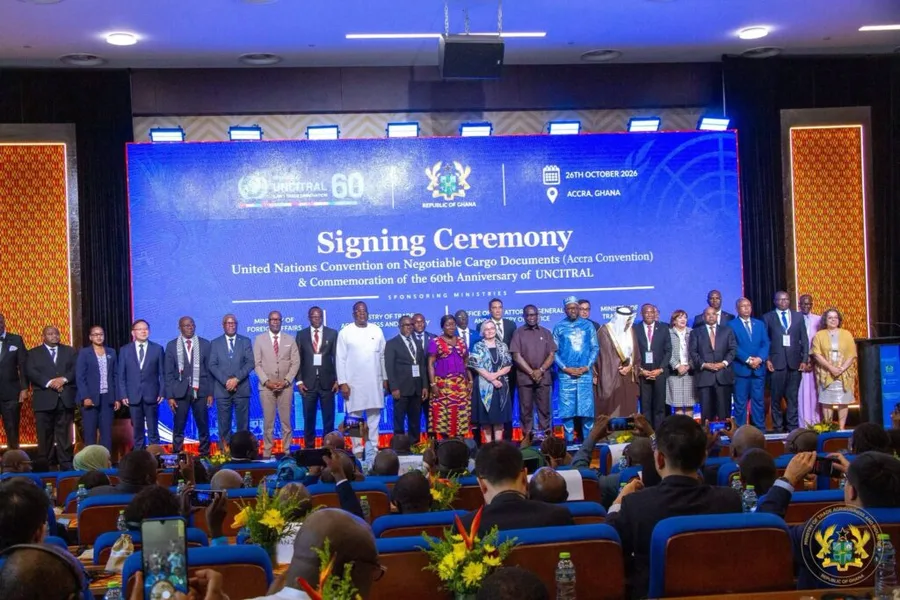
Ghana has become the first country to sign the United Nations Convention on Negotiable Cargo Documents, popularly known as the Accra Convention, as 25 other countries joined in adopting the international agreement aimed at improving trade facilitation, access to finance and digitalisation.
The signing ceremony, held in Accra on Monday, October 26, 2026, brought together representatives from 26 countries to endorse a common legal framework for negotiable cargo documents covering road, rail, air and maritime transportation.
According to a Facebook post by the Ministry of Trade, Agribusiness and Industry, the Convention is expected to address longstanding challenges in international trade, particularly difficulties faced by small and medium-sized enterprises in securing financing using goods in transit as collateral.
Speaking on behalf of President John Dramani Mahama, the Minister for Trade, Agribusiness and Industry, Elizabeth Ofosu-Adjare, said the agreement would help businesses access new financing opportunities while promoting more efficient cross-border trade.
She explained that although maritime cargo documents have traditionally allowed goods to be sold while in transit and used to secure bank loans, similar arrangements have not been widely available for goods transported by road, rail and air.
The Minister noted that the situation has created financing difficulties for businesses, particularly in Africa, where road transport accounts for an estimated 80 to 90 per cent of freight movement.
She further disclosed that intra-African trade represented only 14.4 per cent of the continent’s total trade in 2024, while Africa’s trade finance gap was estimated at between US$74 billion and US$92 billion during the same period.
According to her, the Accra Convention will provide a harmonised legal framework that allows negotiable cargo documents to serve as documents of title across different transport modes.
The agreement will also protect parties who rely on such documents in good faith and give electronic cargo documents the same legal recognition as paper documents.
Madam Ofosu-Adjare reaffirmed Ghana’s commitment to ratifying the Convention and reviewing relevant national legislation to support its implementation.
She said the government would examine laws governing transportation, the sale of goods, electronic transactions, evidence and secured lending to ensure they align with the new international framework.
The Minister also announced plans to pilot the use of negotiable cargo documents in collaboration with the Ghana Shippers’ Authority, Ghana Ports and Harbours Authority, the Customs Division of the Ghana Revenue Authority and financial institutions.
Meanwhile, the Secretary of the United Nations Commission on International Trade Law (UNCITRAL), Anna Joubin-Bret, commended Ghana for hosting the signing ceremony.
She described the Convention as an important step towards reducing legal uncertainty in international trade, improving access to trade finance and strengthening global supply chains.
Ms Joubin-Bret also highlighted the potential of the agreement to support digital trade and regional economic integration, particularly under the African Continental Free Trade Area (AfCFTA).
She urged participating countries to take the necessary steps towards ratification and implementation to ensure that businesses benefit from the new legal framework.
The 26 signatories include Ghana, Sierra Leone, Burkina Faso, Cabo Verde, China, Comoros, Côte d’Ivoire, Cuba, the Democratic Republic of the Congo, Djibouti, Dominica, the Dominican Republic, Gabon, The Gambia, Guinea, Guinea-Bissau, Mauritania, Nicaragua, Nigeria, Pakistan, Rwanda, Saudi Arabia, South Sudan, Togo, Tanzania and Venezuela.
The Accra Convention was adopted by the United Nations General Assembly on December 15, 2025, and named after Ghana’s capital, where it was opened for signature.
The Convention will enter into force after the deposit of the tenth instrument of ratification, acceptance, approval or accession.
The signing marks an initial step towards establishing a unified international system for negotiable cargo documents, with participating countries expected to undertake the necessary domestic processes to give effect to the agreement.
READ ALSO:
Anthony Sarpong writes: Bringing fairness to VAT on foreign digital services
Your past prescriptions haven’t helped developing countries – TOR MD tells IMF
Follow the story
About this article
- Length
- 632 words · 3 min read
- Published
- October 27, 2026
- Byline
- Faridatu Seidu
- Source
- Adomonline.com