

Partnership required to advance workers’ rights – Immanuel …minister emphasises collective responsibility for industrial relations

AI summary
There is no doubt as to the government’s commitment in protecting workers’ rights, and what is required to advance the rights of the working masses is not confrontation but partnership between government, workers, and employers to continuously improve the country’s legislative and industrial relations framework.
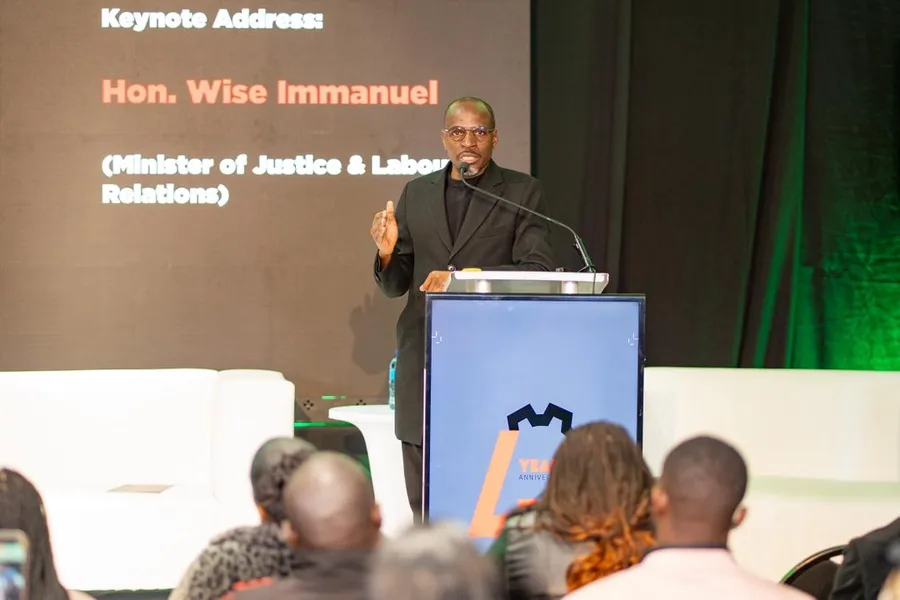
This was the message by Fillemon Wise Immanuel, Minister of Justice and Labour Relations, when he addressed the Mineworkers Union of Namibia (MUN) over the weekend, as it marks its 40th anniversary this year. The minister engaged the union at the launch of a series of four Regional Roundtable Discussions across the country’s mining regions.
“Engagement must be done in good faith. Regulatory arrogance, economic power arrogance, and social arrogance must be rejected. Government, employers, and workers share a collective responsibility to ensure harmonious industrial relations and sustainable economic progress,” Immanuel added.
“Workers’ voices must not remain confined to the shaft, it must transcend the operational circumstances and confinement so that it finds its way into policies, plans, and legislation. Freedom of association, for those who may inform themselves through engagement of literature, Namibia has ratified the ILO Convention 87, speaking to freedom of, or guaranteeing freedom of association and protecting the right to organise. Furthermore, Namibia proceeded to ratify ILO Convention 98, speaking to the right to organise and collective bargaining. The ratifications of government of those two conventions are primarily to give effect to freedom of association as one of the first principles that governs the relationship between the tripartite partners,” said Immanuel.
The MUN’s first roundtable was convened in Swakopmund, under the theme “From the Shaft to the Chamber: Workers’ Voices, National Choices,” and brought together union leadership, members, and key stakeholders for dialogue on labour, economic transformation, and the future of work in the sector.
For four decades, the MUN has remained one of the country’s most established labour institutions, consistently advocating for the rights, dignity, and economic advancement of mineworkers across all mining regions. Against this backdrop, the roundtable series forms part of the union’s 40-year commemoration.
The minister’s address highlighted the significance of direct engagement between government and organised labour. His participation further reinforced the importance of dialogue in shaping responsive labour policies and strengthening worker protections within the country’s evolving economic landscape.
Meanwhile, the MUN’s investment vehicles, the Namibia Miners Investment Trust (NAMIT) and NAM-MIC Holdings, have developed into a diversified economic portfolio valued at over N$700 million. Through these structures, the union continues to support more than 2 600 shareholders, grant beneficiaries across all 14 regions, SME development initiatives, and housing programmes that extend the impact of mining wealth into broader communities.
The NAMIT EduFund grant has thus far empowered 580 recipients, most of them women, through tertiary study, and the MUN is believed to be the first union in Namibia and among the first in SADC to secure full legal cover for its members.
These investment vehicles enable MUN members to participate directly in wealth creation, education funding, enterprise development, and long-term financial sustainability.
MUN members own a 25% stake in NAMMIC through NAMITVEST, making ordinary mineworkers, including ex-miners and their descendants, direct shareholders in the company that invests for them, funded by a simple monthly payroll deduction at employers such as NAMDEB, Swakop Uranium and SPAR Oranjemund.
Acting president of MUN Poco Key Mberiuana, reflected on the challenges the union is currently tackling and urged the members to enlighten the leadership on what needs to be addressed.
“Our focus and commitment is always on what we can achieve. We are here today, most importantly, to say what challenges us as an organisation and how we most want these things to be combated so that we are a worthy union. That’s why it was important for the leadership to go to the grassroots, so that we can be guided from the ground and be directed from there and close the gap,” said Mberiuana.
Moreover, Gerhardus Afrikaner, the Western regional chairperson for the MUN, highlighted the importance of the engagement, highlighting that the roundtables bring decision-making closer to members and ensure that lived experiences of mineworkers directly inform national policy discussions and institutional direction.
“These platforms ensure that the lived experiences of mineworkers are not only heard but are directly integrated into broader institutional direction and national policy discussions. This is critical because policy must never exist in isolation from reality. It must be informed by the daily experiences, challenges, and aspirations of those it seeks to serve,” he shared.
George Ampweya, General Secretary of MUN, highlighted the union’s current and ongoing initiatives that were curated for members.
“We have gone further than just workplace representation and said, let us look at the social circumstances of our members and assist them… Moreover, we introduced the MUN Legal Plan, making MUN the first union in Namibia to provide comprehensive legal cover for members, former members, and dependants through a partnership with LegalWise. Finally, we established the NAMIT SME Fund, providing financing for member-owned and ex-member-owned businesses,” Ampweya conveyed.
The post Partnership required to advance workers’ rights – Immanuel …minister emphasises collective responsibility for industrial relations appeared first on New Era.
Follow the story
About this article
- Length
- 855 words · 4 min read
- Published
- June 22, 2026
- Byline
- Edgar Brandt
- Source
- New Era Namibia