

Hoima and AFCON 2027: Ready for the beautiful game or still warming up?

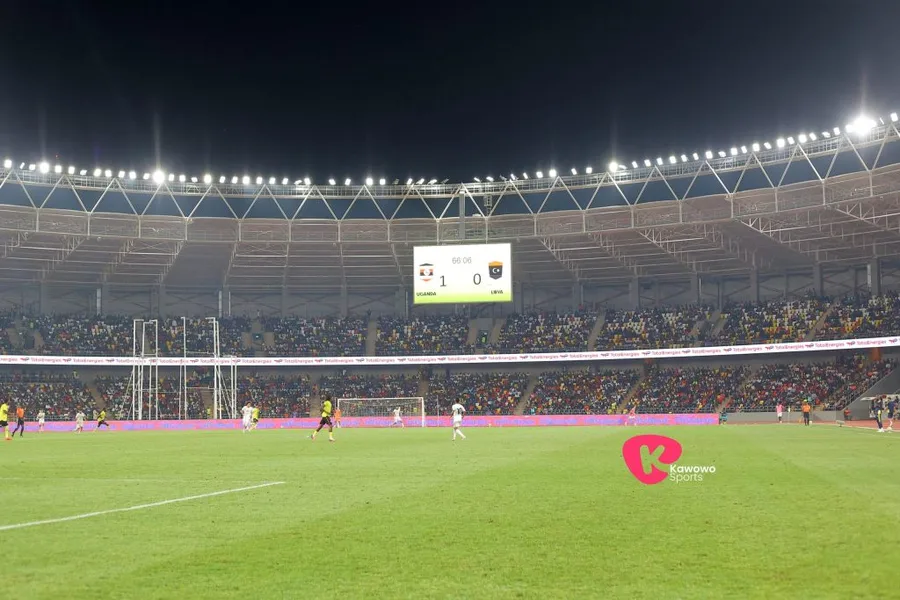
If there was ever a moment for Hoima to announce itself to the African football fraternity, Uganda’s AFCON 2027 qualifier against Libya was it.
For the first time, the Uganda Cranes descended on the newly constructed Hoima City Stadium for a competitive international fixture. The occasion was historic, the atmosphere electric, and the supporters turned up in numbers that would make even Kampala’s most enthusiastic football organisers smile.
Uganda won 1-0, Arnold Vula found the net on his debut, and the Cranes gave the thousands who made the journey a memorable evening.
Credit: John Philip Mugabi
The stadium looked the part. The pitch was immaculate, the stands were buzzing, and the noise from the terraces was unmistakably Ugandan. There was singing, cheering, whistling, and enough ululation to remind anyone who might have forgotten that football in Uganda is not merely a sport. It is an emotion.
But while the Cranes celebrated their victory, another contest was quietly taking place outside the stadium. One that had no referee, no assistant referees and certainly no VAR to review questionable decisions.
It was the battle of Hoima’s readiness to host the continent’s biggest football tournament.
And, frankly, the city still has some homework to do.
Uganda turned up. Hoima, did you see that coming?
Uganda Cranes fans inside Hoima City Stadium Credit: John Batanudde
First, a huge round of applause to the Ugandan supporters.
Getting to Hoima from Kampala is not exactly a quick trip to the neighbourhood supermarket. It is a journey that can take several hours, depending on the state of the roads, traffic and how many times your driver decides to stop.
And this was not even a weekend.
The match was played on a Tuesday, a day when most people are still recovering from Monday and trying to convince themselves that the week will somehow get better.
Yet hundreds of Ugandans packed their bags, abandoned their usual routines and made the journey to Hoima to support the Cranes.
Some travelled by bus, others drove, while many braved the long journey in whatever transport they could find. They came, they sang, they cheered, and they made the stadium feel like home.
The response was remarkable, particularly considering that Uganda had already secured qualification for the tournament. This was, in sporting terms, a match with relatively little at stake for the hosts. Yet the supporters treated it like a final.
The atmosphere was everything one would expect from a Ugandan football crowd. The noise, the excitement and the collective celebrations made it clear that the distance between Kampala and Hoima was no obstacle to national pride.
If this was the response to a qualifier, one can only imagine the excitement when AFCON 2027 finally arrives.
But there is a small problem.
While the supporters were busy demonstrating their love for the national team, Hoima was quietly demonstrating that accommodating such enthusiasm may not be as easy as it looks.
Hoima City Stadium deserves a considerable amount of praise for its performance during the historic encounter. With a capacity of approximately 20,000 spectators, the facility looked impressive and provided an appropriate setting for an international football match.
The playing surface was particularly impressive. It was green, well-maintained and appeared to be in excellent condition. If football pitches could receive compliments, this one deserved a standing ovation.
The seating arrangements were satisfactory, the media tribune provided a suitable working environment for journalists, and the mixed zone and conference facilities were also in place.
The fan zone added to the experience, allowing supporters to enjoy the occasion beyond the 90 minutes on the pitch.
For a country that has often struggled with sports infrastructure, the stadium represented a significant step forward. And on this particular day, it delivered.
The organisation within the stadium, the facilities available to the media and the general matchday atmosphere offered an encouraging glimpse of what Uganda could present to visiting African nations.
However, there is a difference between hosting a football match and hosting the Africa Cup of Nations. A qualifier can test a stadium. AFCON tests an entire city.
And that is where the real questions begin.
Perhaps the most revealing part of the Hoima experience was not inside the stadium. It was what happened when visitors started looking for somewhere to sleep.
By Monday afternoon, hotels in Hoima were reportedly fully booked. This was a single AFCON qualifier involving Uganda and Libya, played on a weekday, with the home team already qualified for the tournament. Yet accommodation in the host city was already proving difficult to find.
Some visitors reportedly had to travel to Masindi to secure accommodation. Imagine travelling several hours to watch your national team, only to discover that the nearest available bed is in another town. By the time you finish celebrating a victory, you still have another journey ahead of you.
Now, imagine the same situation during AFCON. Unlike a qualifier, the continental tournament will attract much more than the usual contingent of Ugandan supporters. There will be visiting national teams, technical officials, referees, journalists, sponsors, scouts, football administrators and thousands of foreign supporters.
Uganda Cranes fans inside Hoima City Stadium during the game against Libya Credit: John Batanudde
There will also be neutral fans who simply want to experience the tournament, as well as supporters who will travel to watch other countries play. And, of course, there will be those who may not even care who wins but would happily travel thousands of kilometres to experience the atmosphere of African football. All these people will need somewhere to sleep.
If a single qualifier can exhaust the city’s hotel capacity, what happens when several thousand additional visitors arrive for an AFCON fixture?
Will supporters have to sleep in Masindi, drive back to Kampala or simply hope that someone has a spare mattress? It is a question worth asking now, rather than when the tournament is already underway.
Hoima needs to assess its accommodation capacity and establish how many visitors it can comfortably host. It must also consider temporary accommodation arrangements and partnerships with hotels and guesthouses in neighbouring towns.
The objective should not simply be to find visitors a bed. It should be to provide accommodation that meets the needs of international football.
If the stadium was the star of the show, the road to Hoima was arguably the biggest disappointment. Getting to the city was an experience that reminded visitors that Uganda’s infrastructure development is still a work in progress.
The road conditions raised questions about how easily supporters, teams and officials will travel to and from Hoima during the tournament. For a regular football match, supporters may be willing to endure a long and uncomfortable journey. After all, there is a football match waiting at the end of it.
But AFCON is an international event, and the expectations are considerably higher. Imagine a visiting supporter arriving in Uganda, excited about watching their national team, only to spend hours navigating difficult roads before finally reaching Hoima.
Or consider the logistical demands of transporting teams, officials, equipment and media personnel between accommodation facilities, training grounds and the stadium. The roads will have to accommodate far more than ordinary traffic.
Of course, road infrastructure falls largely under the responsibility of government. But the question remains: with the tournament approaching, will the necessary improvements be completed in time?
Uganda cannot afford to have a beautiful stadium connected to the rest of the country by a frustrating journey. A stadium may be ready for AFCON, but if reaching it becomes an endurance test, the overall experience will suffer.
The road to Hoima must become more than a route to a football match. It must become part of the country’s preparations to host Africa.
Once visitors finally arrive in Hoima, another challenge awaits: getting around the city. Boda bodas remain a prominent means of transport, and they are certainly useful for moving around town. But while they may be convenient for a quick trip to the market or a nearby hotel, they cannot be the city’s only answer to the transport demands of AFCON.
Not every visiting supporter will be comfortable climbing onto a motorcycle, particularly after travelling several hours to reach the city. Some will arrive with luggage. Others will be travelling in groups, while families will have children and elderly relatives to consider.
And then there are the visiting officials, journalists and football delegations who will need reliable transport throughout the tournament. Hoima needs a more organised public transport system, including conventional taxis, shuttle services and designated transport routes connecting hotels, the stadium and other important locations.
There should also be clear arrangements for airport transfers, team transport and the movement of supporters on matchdays. A visitor should not have to negotiate with five boda boda riders simply to figure out how to get from their hotel to the stadium.
Transport is not a small detail in tournament planning. It is one of the foundations of a successful hosting experience. And if Hoima intends to welcome thousands of international visitors, it must begin thinking beyond the boda boda.
Then there is the question of hospitality. Uganda is famous for its warmth, friendliness and ability to make visitors feel welcome. Hoima has an opportunity to showcase that hospitality to the rest of Africa.
However, hospitality is not simply about smiling at visitors and telling them they are welcome. It also involves providing reliable services.
During the qualifier, getting a meal was not always a straightforward experience. Visitors encountered delays, incorrect orders and inconsistencies in billing. You could order one thing, wait long enough to reconsider your life choices, and eventually receive something completely different.
And just when you thought the experience was over, the bill could introduce another surprise. Of course, food preferences differ, and nobody expects every restaurant to serve a menu that satisfies everyone. But efficiency, consistency and good customer service should be standard.
During AFCON, restaurants, hotels and food outlets will be expected to serve large numbers of people, often within limited periods. Imagine thousands of supporters arriving in Hoima on matchday, all looking for lunch before heading to the stadium.
If the current service challenges are not addressed, some visitors might end up spending more time waiting for food than watching football. Local businesses should therefore begin preparing for the tournament by improving their customer service, training staff and developing systems that can accommodate increased demand.
And perhaps it would not hurt to introduce a little more organisation into the billing process. After all, the only surprises supporters should be experiencing during AFCON should come from the football.
One of the more noticeable differences between Kampala and Hoima was the limited commercial activity surrounding the match.
In Kampala, a major football fixture often creates opportunities for traders, food vendors, merchandise sellers and small businesses. The arrival of thousands of supporters usually means that somebody is selling something.
From football jerseys and flags to refreshments and snacks, matchday becomes an opportunity for businesses to make money. In Hoima, however, the commercial activity around the stadium appeared relatively limited.
There were few visible stalls and roadside vendors taking advantage of the large crowd.
This presents an interesting challenge, but also a significant opportunity. AFCON is not just a football tournament. It is a commercial event that can stimulate business, create employment and generate income for local communities.
Hoima’s traders, restaurants, transport operators, accommodation providers and other small businesses stand to benefit enormously.
However, they need to prepare. Small businesses should also be encouraged to develop AFCON-related merchandise and products that celebrate Uganda’s participation in the tournament. The tournament should not be an event that takes place in Hoima while the people of Hoima simply watch from the sidelines. They should be active participants in the economic opportunities it presents.
Another important consideration is the general organisation of the city. For a tournament of this magnitude, visitors need clear information about where they are going and how to get there. Road signs, directional markings, information centres and clearly identified transport routes will be essential.
A visiting supporter should be able to arrive in Hoima and easily find the stadium, their hotel, restaurants and other important locations. There should also be visible information about match schedules, ticketing, transport arrangements and security procedures.
And while we are at it, the city needs to start building the AFCON atmosphere. Hosting a continental tournament is a once-in-a-generation opportunity for many communities. The excitement should not be confined to the stadium.
Streets, businesses, public spaces and hospitality establishments should all reflect the significance of the occasion. Flags, banners, murals and other forms of public decoration can help create a welcoming environment for visiting supporters.
More importantly, residents should be made aware of the tournament and the role they can play in making visitors feel welcome. Hoima should not wait until the opening match to start looking like an AFCON host city.
That said, it would be unfair to suggest that nothing has been achieved.
The construction of Hoima City Stadium is a major investment in Uganda’s sporting infrastructure, and the successful hosting of the Uganda-Libya qualifier demonstrated that the facility can accommodate a significant international football event.
But the stadium is only one component of the wider preparations. Government agencies, local authorities, tourism officials, transport operators and the private sector must work together to address the challenges identified during the qualifier.
Uganda has already shown that it can build a stadium capable of hosting international football. The next task is to build the surrounding infrastructure and services that will make the entire experience successful.
The post Hoima and AFCON 2027: Ready for the beautiful game or still warming up? appeared first on Kawowo Sports.
Follow the story
About this article
- Length
- 2,285 words · 11 min read
- Published
- October 1, 2026
- Byline
- Grace Kemigisa
- Source
- Kawowo Sports