

Trump’s plan to swing Brazil’s election for Bolsonaro | Ep. 15
Brazil braces for high-stakes elections this Sunday. Trump has been ramping up the pressure, placing the puzzle pieces of U.S. intervention on the country.

https://www.spreaker.com/show/5958129/episodes/feed
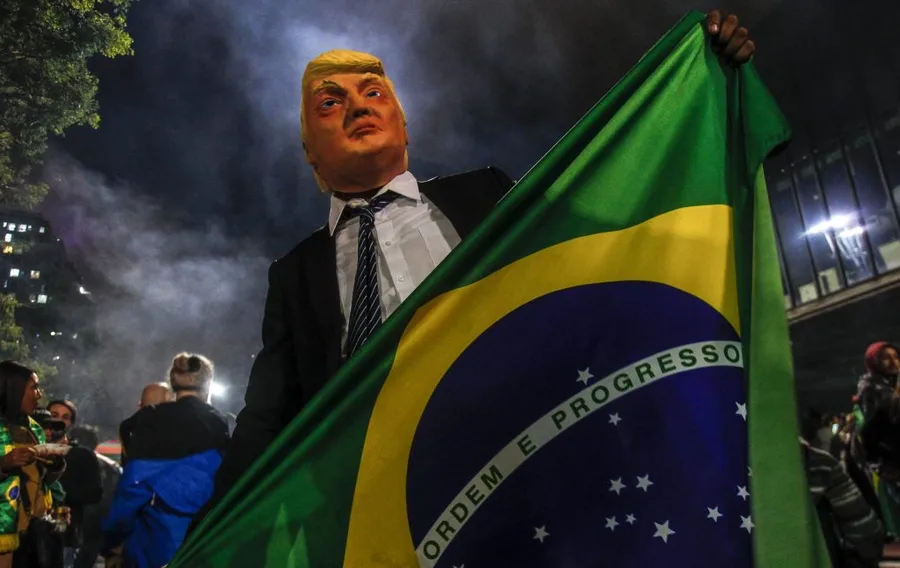
Brazil votes this Sunday, and the Trump administration has spent months trying to tilt the outcome toward far-right presidential candidate Flávio Bolsonaro. Tariffs. Terrorist designations. Revoked visas. Frequent meetings with the Bolsonaro family. Taken alone, each move looks random. Put the pieces together, and a picture emerges: U.S. interference in Brazil’s 2026 elections.
Over the last year, Trump has met frequently with members of the Bolsonaro family. In June, the State Department put two Brazilian gangs on the terrorist list. Just a few weeks later, Trump shared an article on Truth Social that said Brazil was his next big challenge. Less than a month later, in July, Trump imposed new 25% tariffs on Brazilian goods. In August, Trump revoked the U.S. visa of the Brazilian ambassador.
The Brazilian Intelligence Agency recently raised the risk of external influence and interference by the United States in Brazil’s 2026 elections to a quote, “critical level.”
This is Episode 15 of Under the Shadow, Season 2.
Under the Shadow is an investigative narrative podcast series that walks back in time, telling the story of the past by visiting momentous places in the present. Season 2 responds in real time to the Trump administration’s onslaught on Latin America.
Follow Under the Shadow on Spotify and Apple Podcasts.
Hosted by Latin America-based journalist Michael Fox.
This podcast is produced in partnership between The Real News Network and NACLA.
It is supported, in part, by Global Exchange.
VOTE by October 15: Under the Shadow has been nominated for three podcast Signal Awards. Please consider voting for Under the Shadow and The Real News:
- https://vote.signalaward.com/PublicVoting#/2026/shows/craft/best-host-documentary
- https://vote.signalaward.com/PublicVoting#/2026/individual-episodes/craft/most-innovative-audio-experience
- https://vote.signalaward.com/PublicVoting#/2026/individual-episodes/genre/activism-public-service-social-impact
- https://vote.signalaward.com/PublicVoting#/2026/shows/genre/documentary
Panamerican Dispatch
You can check out Michael Fox’s new reporting project on Brazil.
It’s called Panamerican Dispatch. It’s a project of The Real News in partnership with Global Exchange. The website is www.panamericandispatch.org
You can also follow us on social media below
Bluesky https://bsky.app/profile/padispatch.bsky.social
X x.com/PAdispatch
IG instagram.com/padispatch
Tiktok www.tiktok.com/@padispatch
Theme music by Michael Fox’s band, Monte Perdido. Monte Perdido’s 2024 album Ofrenda is available on Spotify, Deezer, Apple Music, YouTube or wherever you listen to music.
Other music from Blue Dot Sessions and Epidemic Sound.
Script editing by Heather Gies. Hosted, written, produced, mixed, and edited by Michael Fox.
**Guests: **
- Alexander Main
- Maria Martha Bruno
- Igor Fuser
**Resources: **
-
Visit Panamerican Dispatch for all of the latest news on Brazil
-
You can visit
Agencia Public
for their reporting and analysis about Brazil.
-
Here is Agencia Publica’s investigación,
Digital Militia
.
-
Many thanks to Jake Johnston from the
Center for Economic and Policy Research
and Maria Martha Bruno, from
Agencia Publica,
for taking the time to speak with me and for their excellent analysis and insight.
-
You can visit CEPR’s
Live Tracker on Latin America
.
-
You can check out
Michael Fox’s Patreon
.
-
More background…
-
The Beginning: Monroe and migration | Under the Shadow, Episode 1
-
Panama. US Invasion. | Under the Shadow, Episode 13
-
The legacy of Monroe | Under the Shadow, Bonus Episode 4
Support Under the Shadow
Please consider supporting this podcast and Michael Fox’s reporting on his Patreon account: patreon.com/mfox. There you can also see exclusive pictures, video, and interviews.
You can subscribe to Michael Fox’s new free speech podcast, **The Battle for Free Speech **on Spotify, Apple Podcasts, or wherever you get your podcasts.
Transcript
The following is a rushed transcript and may contain errors. It will be updated.
Michael Fox:
Hi folks. This is your host, Michael Fox. Before I get started, I wanted to let you know that I have big news. First, this season of Under the Shadow has been nominated for three podcast Signal Awards. It’s really exciting, and you can help us by heading over to signalaward.com and voting for Under the Shadow. I’ll add direct links in the show notes that will take you straight there. Second, last week I launched a new website called Pan American Dispatch. It’s a project of the Real News. We’re translating daily articles from Portuguese and Spanish into English for a US audience. Over the next two months, we’ll be exclusively focused on covering the Brazilian elections and Trump’s attempts to sway them. That is what this entire episode is about. And if you want to get all of the news about what’s happening in real time, please consider subscribing to our Substack.
You can find us at panamericandispatch.org. We’re also on X, Blue Sky, Instagram, and TikTok. Our handle is @PAdispatch. Okay, that’s it. I hope you enjoy the show. On May 26th, 2026, a 45-year-old Brazilian senator named Flavio Bolsonado met with US President Donald Trump at the White House. Flavio is the presidential candidate for the far right in Brazil in the upcoming elections in October. This is what he had to say at the annual conservative political action committee meeting in Texas earlier this year.
Flávio Bolsonaro:
And let me look you in the eyes and tell you, we will win.
Michael Fox:
Flavio is the son and political heir of the former far right president Jair Bolsonado, a close ally of the US president. In the meeting at the Oval Office in May, Flavio Bolsonado reportedly asked Trump to designate the Brazilian drug gangs, Primero Commando de Capital and the Commando Vermelio as foreign terrorist organizations. After the meeting, Flavio spoke to the press.
He said, “I asked President Trump emphatically to designate as soon as possible the PCC and the Commando Vermelio as foreign terrorist organizations.” This might not seem like such a big deal, but it is. The United States has sometimes used that very designation as the pretext to invade or interfere in foreign countries. The US placed the Venezuelan gangs, Trende Aragua and Cartel de los Soles on the list back in 2025, and fighting those alleged terrorists was one of the excuses the United States used for invading Venezuela and kidnapping President Nicholas Maduro on January 3rd of this year. In other words, this designation carries weight.
Trump agreed to Flavio’s request. Just three days after meeting with Flavio Bolsonaro, US Secretary of State Marco Rubio announced that those two Brazilian gangs would be added to the list of foreign terrorist organizations. Flavio responded in a letter to Rubio, thanking him for the classification and offering to place his transition team at the disposal of the White House if he’s elected. For months, the United States has been escalating the pressure on Brazil in the lead up to the presidential elections with the goal of helping to lift Flavio Bolsonaro to the top office. Just a few weeks after the State Department put the Brazilian gangs on the terrorist list, Trump shared an article on Truth Social that said Brazil was his next big challenge. Less than a month later in July, Trump imposed new 25% tariffs on Brazilian goods. In August, Trump revoked the US visa of the Brazilian ambassador.
It was an apparent tit for tat after Brazil denied visas to two US State Department officials who planned to travel to Brazil to meet with former President Jair Bolsonaro. I could go on. The point here, as many people have pointed out, is that there isn’t just one thing that Trump is doing to try and sway the vote in favor of Bolsonaro. It’s a whole combination of moves, like a jigsaw puzzle with many pieces taken alone, and it’s just a random assortment of colors and shapes. But when you start to put the pieces in place, a picture begins to emerge. See, Trump allies have won big elections across Latin America. In recent years, right-wing candidates have taken back or held onto power in Argentina, Chile, Colombia, Ecuador, Honduras, Bolivia, and Peru. And they’ve done so with the help of US President Donald Trump, who’s thrown his weight around to boost right-wing candidates, and also with the support of bot farms and shady electoral campaign practices linked to Washington and Mar-a-Lago, as we looked at in the last episode.
Donald Trump:
But on this historic day, we come together to announce a brand new military coalition to eradicate the criminal cartels plaguing our region.
Michael Fox:
Many of those countries have now joined forces in Trump’s shield of the America’s alliance, but there are a few holdouts, and Brazil is one of the most important.
Alexander Main:
The upcoming election in Brazil is really going to be extremely consequential for the entire region.
Michael Fox:
Alexander Main is the director of international policy at the Center for Economic and Policy Research.
Alexander Main:
Brazil is the country with the largest economy, biggest population in Latin America, and it’s also one of the few countries that is still holding out against US pressure, pressure to align with the Trump administration’s agenda in the region.
Michael Fox:
The first round election is on October 4th in just a couple of days, and the runoff will take place three weeks later on October 25th. Bolsonaro is facing off against the longtime workers’ party icon, Luis Ignacio Lula de Silva. He’s the current president and he’s running for reelection. I have been covering the campaigns here in Brazil in recent weeks. I’ve attended rallies for both Lula and Bolsonaro. Today, I’m going to walk you through what’s at stake, and most importantly, how Trump is exerting underhanded pressure on the country ahead of the vote. As a leak document showed last week, the Brazilian Intelligence Agency has raised the risk of external influence and interference by the United States and Brazil’s 2026 elections to a “critical level.” According to the report, there is a trend of escalating pressure on Brazil and a quote, “selective intensification and reconfiguration of the pressure exerted by the United States.” It’s a textbook example of foreign election interference today, a multifaceted jigsaw.
People are concerned, but they’re also standing up, and that’s what makes this episode so interesting. It’s happening in real time. You have Trump attempting to sway the vote, and you also have people pushing back.
Like Lula’s recent speech at the United Nations where he told the US president that Brazil will not be the backyard of any country.
Or this woman, a small farmer who I spoke with at a Lula rally in Southern Brazil. “We’re not afraid of Trump, “she said. “We know what he wants to do and we’re not going to let him. We are the resistance. We’re not afraid of him, just like Lula isn’t afraid. Lula showed us that we are not less than any country,” she said. That and so much more in a minute. This is Under the Shadow, an investigative narrative podcast series that looks at the role of the United States abroad in the past and the very present. This podcast is a co-production in partnership with The Real News and NACLA. I’m your host, Michael Fox, longtime radio reporter, editor, journalist, the producer and host of the podcast’s Brazil on Fire: Stories of Resistance and my new series, The Battle for Free Speech. I’ve spent the better part of the last 20 years in Latin America.
I’ve seen firsthand the role of the US government abroad, and most often sadly, it is not for the better. Invasions, coup, sanctions, support for authoritarian regimes. Politically and economically, the United States has cast a long shadow over Latin America for the past 200 years. It still does. This is season two of Under the Shadow Trump’s attack. Episode 15, election meddling in Brazil.
Okay, before we dive into the allegations of election interference, let me set the scene. To do that, I want to take you back to a month and a half ago to the launch of the campaigns here in Brazil. I was in Sao Paulo covering Lula’s kickoff. Some of this section of the episode is based off of reporting I did at the time for the world and the real news. It’s August 16th, 2026. Tens of thousands of supporters of President Luis Idnacio Lula de Silva are packed into May 1st stadium in Sao Paulo. Among them is Sida Maya. She’s the secretary of women’s public policies in the nearby municipality of Maua.
“This is living history,” she says. “I’m participating in a historic moment. It’s a great feeling and we’re going to elect Lula.” Next to her, her husband Valmirmaya holds back tears. “It’s emotional, “he says. Lula’s campaign chose this stadium to kick off his run for a fourth and final term as president. This is where Lula got his start. In 1979, Lula was a young leader at the ABC Medal Workers Union. He led an iconic strike and rally at this same stadium. The workers won and it marked the beginning of the end of the country’s military dictatorship. Valmir Maya was there then and he’s here now.
“We wanted what we got,” he says, “to transform Brazil into a democratic country. That was our struggle, and Lula was the expression of this.” Inside the stadium, President Lula strode onto a long stage wearing a Panama hat and a white shirt. From the bleachers, he seemed to float above the sea of supporters in red, the color of Lula’s workers’ party. Lula’s top campaign promise has always been about battling hunger. Over the years, he’s lifted millions from poverty, increased access to education, health, and infrastructure, in particular in impoverished Northeastern Brazil. Lula told the crowd that there was much work left to be done, that they had to think of the future. He said they had to invest even more in education, that he wanted to continue to develop jobs and industry for Brazil. 300 miles to the east, Lula’s challenger, Flavio Bolsonaro, launched his campaign on Copacabana Beach in his hometown of Rio de Janeiro.
“Come with me and rescue our nation,” he said, “God above everyone, Brazil above all.” Flavio Bolsonaro has attacked the left and promised to fight crime and insecurity, cut bureaucracy, promote private business and privatizations, and develop close ties with the United States. Much of his rhetoric and that of his supporters is wrapped in a religious language of good versus evil.
“You are the son of hope,” said a pastor at his campaign launch. “You are the first born. You received the legacy of representing your father, and now for everything that is sacred on the face of the earth, honor your father. “The savior trope goes over well with his evangelical supporters, an important base for Bolsonaro and other far-right politicians in Brazil, as we looked at in depth in my 2022 podcast, Brazil on Fire. Blase Narujo is a youth pastor at an evangelical church in a working class neighborhood of Sao Paulo. He joined others on the streets in mid-August to promote Bolsonaro and other far-right candidates running for local office.
He said,” I believe that Flavio Bolsonado is the only viable candidate who can beat Lula and the workers’ party. “I’m a Christian here,” he told me. “I behave as a Christian, but I’m also a political activist here on the streets to defend my beliefs,” he said. Flavio Bolsonado also has powerful support in high places, in particular, as we heard earlier from Donald Trump. If you remember, the US president is a longtime ally of Flavio’s father, Jair Bolsonado. Jair is currently on house arrest. He was first barred from running for office for spreading lies about the country’s electoral system. Last year, the Supreme Court convicted him of plotting a coup to return to power. Before his rise as the leader of Brazil’s far right, Jair Bolsonaro was a backbench congressman for decades, outlandish, but mostly obscure. And then he ran for president.
Speaker 5:
There are a few things that drew inspiration for you.
Jair Bolsonaro:
Very special guy. Turned out to be a great friend of mine.
Michael Fox:
Bolsonaro fashioned himself after Trump. In fact, in Jair Bolsonaro’s electoral campaign in 2018, international media often called him the Trump of the tropics. He and Trump met a number of times while they were both president.
Jair Bolsonaro:
And I think we can say that Brazil and the United States are as close or closer as they’ve ever been.
Michael Fox:
Last year, Trump imposed 50% tariffs on Brazil in part because of the country’s criminal trial against the former president.
Donald Trump:
They’re treating President Bolsonaro very unfairly. He’s a good man. I know him well. I negotiated with him.
Michael Fox:
And let me be honest, there are many supporters of Bolsonaro who look up to Trump and want him to use his leverage to help their candidate, Jair Bolsonaro’s son and protege Flavio Bolsonaro. On September 7th, members of the far right in Brazil hit the streets across the country to rally for Flavio. I covered the march in the southern Brazilian city of Florianopolis. There, numerous people told me how much they admired Trump and how grateful they were for his support. Adalberto Luis de Santos is marching with a blue hat with the insignia of the United States. He and his wife are draped in Brazilian flags. “We’re hoping for support from the United States,” he said. “I believe Trump can help us. All Brazilians need the support of someone from abroad. “. “Trump is really important,” another man in the march told me. “The external pressure is very important.
“. A woman in the march carrying a flag and a yellow hat told me,” Just the simple fact that Trump is in power and acts democratically in favor of freedom makes all of the difference for our people. “.
“We don’t want Brazil to turn into another Venezuela,” she said. “I’ve heard that narrative countless times in Brazil and during elections in countries across Latin America for years. It’s the ever-present boogeyman of so-called communist Venezuela, but fear of the Venezuelan fate took on an even more serious dimension after the US invasion of Caracas earlier this year. The sentiments of so many Bolsonaro supporters are a sign of just how polarized the political debate is and how much the far right in Brazil looks up to the US president. Two weeks later, I covered another rally in the same city, this one in support of President Lula.
People had a lot to say about Trump and his efforts to influence their presidential decisions. I asked them, “Are you afraid of what Trump and the United States could do during this election to try and support Bolsonaro?” “Yes, I’m really afraid of that, “said one man carrying a Lula flag. “They want to take away our sovereignty. They want to invade our lands. They want to take what is ours and let Brazil be a colony of another country.” “Of course we’re afraid, “said someone else,” but we believe that Lula is well ahead in the election and we won’t allow Trump to destroy the election. “What do you think about Trump and are you concerned that Trump might try and do something with the elections here in
Speaker 7:
Brazil? Yeah, we’ve seen a lot of his work here in Latin America that we are very scared. Venezuela, Peru, Colombia, Argentina. So we are very scared because Latin America is being contaminated by him and his work, so it’s very scary and we don’t want him in here or anything with him.
Michael Fox:
People have a lot to be concerned about. When I was in Sao Paulo in August, I sat down with Igor Fusser at a cafe near Palista Avenue. We’ve known each other for years. He’s a professor of foreign relations at Brazil’s ABC Federal University. I asked him how he sees the US actions against Brazil at this moment.
He said, “This is not just about the United States trying to remove the government of a left-wing party, the workers’ party, or a left-wing leader, which is Lula. It’s about subjecting Brazil to the policies of the United States, and Brazil being the largest country in Latin America is precisely the biggest obstacle to the American project of global dominance of the Western hemisphere,” he said. Remember, over the last year, as we’ve looked at throughout this podcast, Trump has pushed the United States into a new era of dominance over Latin America, the likes of which the region has not seen in decades. Boat strikes in the Caribbean, the US invasion of Venezuela, and the kidnapping of President Nicolas Maduro, the oil blockade on Cuba, and Trump throwing his weight around and meddling in elections across Latin America. It’s all justified by a renewed Monroe doctrine. Here’s Secretary of War, Pete Hegseth, underlining that point.
Pete Hegseth:
President Trump has established the Trump corollary of the Monroe Doctrine, the Don Roe doctrine, and the war department is implementing it as fast as we can.
Michael Fox:
Brazil is the latest battleground. It’s playing out in the open and behind the scenes. It’s early August. The Brazilian Association of Investigative Journalism is meeting in Sao Paulo. At the meeting circulating in the crowd are staff from the US Consulate in Sao Paulo, their mission to woo Brazilian journalists into conversations about the country’s electoral process and the state of “freedom of expression” in the country. This was reported by several independent journalists at the conference and then published by independent journalist Leandro DeMori, the former executive editor of The Intercept Brazil. According to Demorti, three journalists at the event confirmed the actions of the consular officials. Two journalists said they were offered assistance with US visas if they needed them, even though the meetings with the officials about the country’s elections were to be held in Sao Paulo.
Washington has leaned on two key narratives to demonize Brazil in recent years. One, that freedom of expression is under attack in Brazil because of its attempts to reign in social media disinformation, and two, that the country’s electoral system is faulty and prone to errors. Both of those claims are false. Brazil has long held certified free and fair elections, and freedom of speech is alive and well, although Brazil embraces a more inclusive harmonious definition of how the freedom of speech fits into the country’s other laws. Episode 12 of this series goes deeper into those claims and their fallout. DiMorti’s reporting about the recent journalism forum brings up more questions than answers. What were the consular officials trying to achieve? Did some journalists take the bait? If so, how will this be weaponized? We don’t have answers, but it’s another piece of the scrambled jigsaw puzzle.
Here’s another, and it’s just one example of how the meddling campaign has been building. In mid-September, less than two weeks ago, Flavio Bolsonaro’s brother, Eduardo, met with President Donald Trump at the White House. As we looked at in the last episode, Eduardo is a former congressional representative who now lives in the United States. The Brazilian Supreme Court sentenced him earlier this year to four years in prison for his actions in the US, lobbying the Trump administration to intimidate the Brazilian judiciary amid the trial against his father. According to reports, Eduardo traveled to Washington to ask Trump to impose sanctions on members of the Lula government and the Supreme Court, including Justice Alexandre Morais. If you’ve been following Brazil or my reporting, you might remember that Morais was the justice that led the trials against the dissemination of fake news in the country and also against Jair Bolsonaro.
Jair Bolsonaro:
Also developing this morning, the Trump administration placing sanctions on a Brazilian Supreme Court justice over concerns of human rights violations and politicized prosecutions.
Michael Fox:
Last year, the US sanctioned Mordice for supposedly carrying out human rights abuse, including arbitrary detention. Those sanctions were lifted four months later, but they were a thinly veiled retaliation for the trial against Bolsonaro and also Morais’s fight with ex-owner Elon Musk, which we looked at in depth in episode 12. There is no question the battle over Brazil right now is also taking place online and Silicon Valley is playing its part.
On Wednesday, September 23rd, Meta, the parent company of Facebook and Instagram, took down President Lula’s Facebook page and blocked his campaign from running political ads. The platform gave no justification for the move. Lula’s workers’ party and his electoral coalition demanded answers. Lula’s campaign asked for the immediate return of the account. The campaign’s lawyers told the platform that the restriction “poses a serious risk to the candidate’s level playing field in the election.” The head of the Workers’ Party national communications team, Eden Valadaris, said they hadn’t ruled out taking the case to the superior electoral court. He wrote on X, “Brazil’s electoral contest, its campaigns, and its vote cannot be left to the mercy of the political preferences of the big tech companies whose supposed programming errors only hit and harm one campaign and one candidate.” One candidate, meaning Lula. By the next morning, the page was back up, but Lula’s electoral coalition said Meta’s actions harm the presidential campaign.
Remember that Meta was founded and is run by Mark Zuckerberg. He’s a close ally of President Donald Trump.
Jair Bolsonaro:
Thank you very, very much.
Michael Fox:
In fact, he was at Trump’s inauguration for his second term alongside the heads of Apple, Google, Amazon, and of course, Tesla and ex – CEO, Elon Musk. I want to talk about something important today because it’s time to get back to our roots around free expression on Facebook and Instagram. Zuckerberg got rid of fact-checking at Meta in early 2025, just before Trump came into power last year, and that’s important because there are now fewer constraints on the spread of fake news or misinformation on the platform. In late August, Amnesty International tested this lack of guardrails in Brazil. It sent 15 different AI-generated election-related political disinformation ads to Facebook to see if the platform could discern between truth and falsehood. Meta failed to block most of them. A similar test run by the eco movement in Brazil in mid-September showed that nearly 90% of the disinformation ads it attempted to run on Meta were approved, including “AI ads depicting execution style threats against lawmakers and calling for a stop the steal style coup.” And I want to say one more thing about the role of Silicon Valley’s big tech platforms.
They are paying attention to what’s happening in Brazil. Here’s just one example. Last year, lawmakers and a congressional committee in Brazilia were discussing a bill on AI regulation. According to the fact-checking agency, Ausfatos, big tech lobbyists visited committee members more than 80 times over a five-month period. The tech company that met with members in Brazilia the most was Meta, which made more than a third of those visits.
There’s another layer to all of this, another puzzle piece if you like. In the last episode of this podcast, I took an in-depth look at the work of the Argentine political strategist, Fernando Cerimedo. Remember, Serimedo has led right-wing digital campaigns across Latin America, and he did so with the help of Washington and Trump’s former campaign manager and digital strategist, Brad Parscali. This is what he had to say earlier this year in Mar-a-Lago when he was presented an award for best Hispanic Political Consultant of the Year.
Jair Bolsonaro:
I want to say something in English. Thank you to Brad Parscale for believing me all the time and give me your technology and Tim Don for the fighting in Latin America against socialism. Thank you, Brad.
Michael Fox:
Serimedo is now in prison on charges that he tried to kill his girlfriend. According to her, he hired the hitman to silence her. Serimedo also faces charges of illicit enrichment and other crimes, but his digital campaigning and the bot farms that he’s deployed in elections up and down the hemisphere haven’t necessarily gone away, nor have his deep ties to the right in the region. Remember who presented that award to Cerimedo? It was Eduardo Bolsonaro, the brother of Flavio Bolsonaro. They reportedly have known each other for more than 15 years. Now, just this week, Washington sanctioned Bolivian Attorney General Roher Mariaka, who is prosecuting the Serimero case,
He defended his country sovereignty and vowed to continue the investigation despite the apparent attempt to intimidate him. I mention all of this to say that just because Serimedo is now in jail, it doesn’t mean that these types of digital influence campaigns heavily fueled by an inter International far right aren’t happening. As I mentioned last time, Serimedo is just one piece in a puzzle, a cog and a wheel, albeit one very important cog. But actions pushing disinformation online are still happening. We just don’t necessarily know from who or where. Here’s one example. About a week ago, the Brazilian journalistic outlet Ajencia Publica reported in conjunction with Aos Fatos that AI farms were fueling the far right agenda in the lead up to the elections. The bots had created 255 profiles and made over a thousand posts. Agencia Publica reported that the network had “achieved 58 million views, expanding the reach of posts supporting the Bolsonaro family and attacking the Supreme Court.” It’s a strategy known as astroturfing, using artificial engagement to give the impression of a real surge in grassroots support.
All of this happened over one month between August and September. According to the investigation, one of the main nodes of this AI campaign was linked to the Instagram account Leo Indio Bolsonaro. That is managed by Leonardo Rodriguez de Jesus. He is Flavio and Eduardo Bolsonaro’s cousin. He was investigated by Brazilian officials for his role in the 2023 attempted coup. A warrant for his arrest was ordered in 2025. He fled the country. He’s reportedly now in Argentina. The point is this, these campaigns are happening. We often just don’t hear about them until after the fact.
Maria Marta Bruno:
Well, I’ve been voting since 1998 and I have never seen such level of interference of foreign interference in Brazilian elections.
Michael Fox:
Maria Marta Bruno is a journalist with Agencia Publica, the outlet I mentioned earlier. If you remember, I spoke with her in the last episode as well about Serimedo.
Maria Marta Bruno:
It reminds me a lot of what I have read in history books and what I have learned on the Brazilian dictatorship and the very clear role that the US developed from 1964 to 1985 when the military dictatorship in Brazil took place. There was never since the end of the dictatorship such open intervention.
Michael Fox:
Maria says there have been a lot of headlines lately mentioning diplomatic tension between Brazil and the United States, but she says what we’re seeing goes far beyond that.
Maria Marta Bruno:
Because given the gravity and the timing of the recent facts, I would say that it constitutes a clear interference in our process.
Michael Fox:
She highlights Trump’s tariffs on Brazil both last year and this year, which she says are wrapped into defending former President Jair Bolsonaro. She points to the numerous meetings between Flavio and Eduardo Bolsonaro with top officials in Washington over the last year, the US sanctions against Supreme Court Justice Alexandre Morais and so much more. And she says there are two other big reasons why the United States is so interested in Brazil. The first is China.
Maria Marta Bruno:
The US intentions to reduce China influence in Latin America. We all know that China, it’s a key partner for Brazil and for other countries in the region.
Michael Fox:
The second is rare earth minerals, stuff like neodymium, dysprosium, or terbium. Yeah, I don’t know what they look like either, but they’re used in EV motors, green energy technologies, military equipment, and other industries. Brazil is home to somewhere between a fifth and a quarter of the total rare earth reserves in the world. It’s second only to China. In April, a US company bought up the Brazilian firm Ceja Vergi, which mines rare earth minerals in Brazil. After his meeting with Trump in May, Flavio Bolshinaro promised to work with the United States on mineral extraction. “We are the only real alternative to China for a free world,” Flavio Bolsonaro said. “Under my government, there will be long-term strategic partnership with the United States in this sector with protected investment and shared reindustrialization between the two countries. Flavio also promised that if he is elected in his first month, Brazil would join President Trump’s Shield of the America’s regional coalition.
Brazil will join the shield of the Americas together with the United States, “he said,” and countries across the region, forming a great hemispheric alliance against terrorism and organized and transnational crime. “This is Brazil’s place. It is the protagonist of the security of the Americas side by side with free and sovereign nations, he said.
Maria Marta Bruno:
And we know that the US is very interested in what we have and the reserves that we have. So it’s very significant, it’s very important, and we know that the US is following closely the development of the presidential elections here because they will certainly determine what will be the future of the diplomatic relation between US and Brazil in the upcoming years.
Michael Fox:
In the face of all of this, Brazilians are responding none louder than President Luis Idnacio Lula de Silva.
Jair Bolsonaro:
The assembly will now hear and address by his excellency, Luis Inacio Lula Da Silva, president of the Federated Republic of Brazil.
Michael Fox:
The day is September 22nd, 2026, New York City. Brazilian President Luis Idnacio Lula de Silva walks to the podium at the United Nations to kick off the 81st General Assembly meeting. Without mentioning him, Lula speaks directly to US President Donald Trump. “Brazil does not fit into anyone’s backyard,” he says. Lula denounces Trump for attacking democracy, interfering in elections and using military force to acquire material resources across Latin America. He closes his speech with a nod to the upcoming high stakes elections in Brazil. On October 4th, he says, “Millions of Brazilians go to the polls to decide their future. They will not just elect the president of the republic, state governors, and representatives of the legislative power. They will decide between democracy and denialism, between if Brazil is going to move toward a future of more opportunities or return to a past of exclusion.”. He says Brazil will have free and transparent elections as it always has with broad freedom of speech.
He denounces the spread of disinformation online, in particular coming from outside the country, which he says is an attempt to “disrupt the debate.”.
“We have a modern and robust electoral system,” he says. “We have a plural citizenship and a free press. We will not allow the enemies of democracy, both internal and external, to attack the popular will. Brazilian democracy belongs to Brazilians. Brazil will continue to be a sovereign country. No one, no one will take us away from this path, “he says. It’s Lula’s response to Trump and the world as the country faces incredibly important elections, elections that Trump and the United States have been attempting to influence. Brazilians have been vocal online and in the streets against Washington’s pressure, and recently they actually got some support from a group of lawmakers on Capitol Hill. On September 24th, just last week, Senator Bernie Sanders and 30 Democratic members of the US House of Representatives sent a letter to Secretary of State Marco Rubio. They accused the Trump administration of waging a pressure campaign against Brazil ahead of the first round vote.
Illinois Congresswoman Delia Ramirez led the congressional effort. They write, “We are writing to express our grave concern regarding the administration’s coordinated effort to threaten our strategic alliance with Brazil and undermine the Western Hemisphere’s second largest democracy ahead of its upcoming presidential election in October 2026. Over the course of President Trump’s second term,” they write, “We have seen US officials engage in a sustained multifaceted campaign of interference and destabilization in Brazil. They point to the shocking 50% tariffs Trump levied on the country last year amid the country’s trial against Jair Bolsonaro. They also underscored Trump’s appointment last year of Darren Beattie as a senior advisor on Brazil issues in the State Department. Beattie, a noted far-right extremist and white supremacist,” they write, “came into this post with a clear record of public statements signaling an overt ideological commitment to undermining Brazil’s democratic institutions.” The congressional representative singled out Trump’s current tariffs, his meeting with Flavio Bolsonaro at the White House, and his designation of the Brazilian drug gangs as foreign terrorist organizations.
They write, “Given the Trump administration’s repeated military strikes in the region, justified in part by alleged foreign terrorist organization threats to US security, the designation has also fueled fears of potential US military intervention.” They recall comments from White House Press Secretary Caroline Levitt last year that threatened Brazil could potentially face the United States’ military might.
US military action in Brazil isn’t likely, but it’s not out of the question. Nothing is under Trump’s Dunro doctrine. The lawmakers highlight that Brazil is just the latest in a quote, deeply troubling pattern of interference by the United States in foreign elections, including in Argentina, Honduras, and Columbia. Rather than helping defend democracy, they write, the United States is acting as an agent of interference and destabilization using diplomatic economic and political pressure in ways that risk weakening the country’s democratic institutions, undermining confidence in Brazil’s electoral process and inflicting further damage on our relationship with a strategic US ally and trading partner. They demand that Washington commit to recognizing the certified election results. Here’s the thing, the stakes are high. Remember Igor Fusser? He’s the professor I met at the Sao Paulo Cafe. He told me, “It’s clear that the United States is doing everything and will do everything possible to prevent the reelection of Lula in the next elections.” And Igor told me there was a reason for that, because if Flavio Bolsonaro wins, he will bow to Trump and the United States.
Igor says, “Brazil will become a country under the tutelage of the United States, a colony or almost a colony of the US as already happened with Argentina, Columbia, Venezuela, and many others. And if Lula is victorious in these elections, we will live a very intense period of confrontation between the two countries,” he says. And Igor has a really interesting analysis here. He says, “The US dominance over Latin America imposed by Trump is analogous to the control of the Soviet Union over the Eastern block countries during the Cold War under a Russian foreign policy imposed by Soviet leader Leonid Brezniv in 1968.” He says, “Czechoslovakia, Hungary, Poland, Bulgaria, all of those countries were formally independent nations with their own government, their own laws, their own representation in the United Nations, but these countries were not autonomous. They didn’t have sovereignty. Any movement that they made that clashed with the interests of the Soviet Union was repressed.
Some of them were even invaded,” he says. “So we’re living in Latin America, a Breznev doctrine, capitalist, imperialist, dictated by Donald Trump. “That is why this election is so important. Brazil is the outlier, the counterweight to the United States and the region, and the US is fighting hard to bring it to heel.
We’re going to see this all unfold not in a couple of months or weeks, but in just a few days. The first round of the election is on October 4th. Brazilians are voting for their president and vice president. They’re also voting for all of the country state governors, all 513 members of the Chamber of Deputies, two-thirds of senators, and more than a thousand state assembly seats. Lula is ahead in the race, but he appears shy of the 50% needed to win outright. If no presidential candidate wins more than half of the vote, it’ll go to a second round. There, polls show the margin between Lula and Bolsonaro even tighter, and it will undoubtedly be a tough campaign. The second round, if it’s needed, is on October 25th.
That is all for this episode of Under the Shadow. Things are going to get intense in the coming days. Please consider following our new website, Pan-American Dispatch and our social media accounts for ongoing reporting on Brazil and these elections. Some of the reporting in this episode was based off of stories I produced recently for the world and The Real News. Many thanks to those outlets for all that they do. Let me remind you that if you’re craving even more backstory here, you can always go back and listen to episode 12 of the second season of Under the Shadow about Brazil’s fight against fake news in the country and the US attempt to roll it back. And please also consider checking out my 2022 podcast about Brazil under Bolsonaro. It’s called Brazil on Fire. It’s still totally relevant today. You can find that wherever you listen.
As always, you can find me at patreon.com/mfox.
There you can also support my work, become a monthly sustainer, or sign up to stay abreast of all the latest on this podcast and my other reporting across Latin America. You can find a ton of content there exclusively also for my supporters. If you’re looking for more information, news and reporting on Trump’s onslaught, both in communities within the United States and abroad, please check out The Real News and NACLA. Both of them are publishing daily indispensable reporting. The theme music is by my band, Monte Perdido. You can find us on Spotify or wherever you stream music. This closing song playing right now is off our 2024 album, Ofrenda. I hope you check it out. Under the shadows of co-production of The Real News and NACLA, it’s produced in partnership with Global Exchange. This episode was written, researched, reported, and produced by me, Michael Fox. The script was edited by Heather Geis.
Thanks for listening. See you next time.
Follow the story
About this article
- Length
- 7,085 words · 35 min read
- Published
- October 1, 2026
- Byline
- Michael Fox
- Source
- The Real News Network