

Political independence earned under Nkrumah is being eroded – P.L.O Lumumba
Renowned Pan-Africanist Professor P.L.O. Lumumba has warned that the political independence achieved by African countries during the era of Ghana’s first President, Dr Kwame Nkrumah, is gradually being eroded by external economic and political influence.

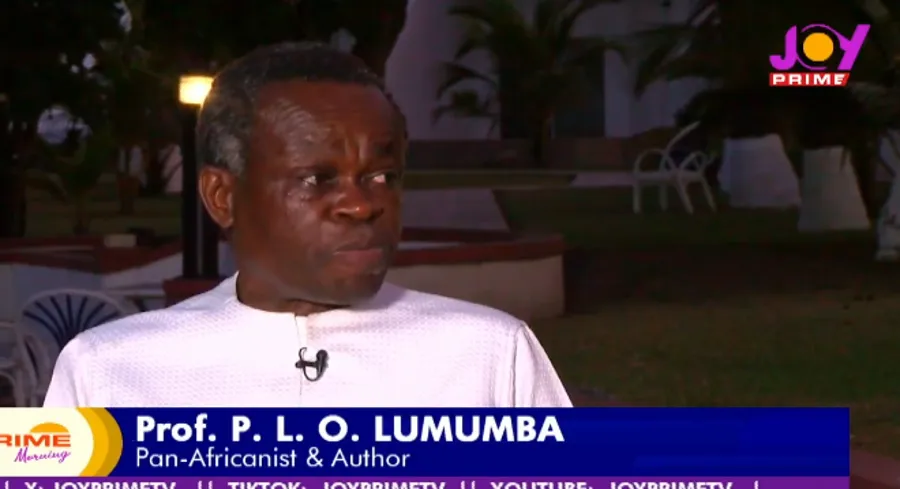
Renowned Pan-Africanist Professor P.L.O. Lumumba has warned that the political independence achieved by African countries during the era of Ghana’s first President, Dr Kwame Nkrumah, is gradually being eroded by external economic and political influence.
Prof. Lumumba said that although African countries attained formal independence from colonial rule, many continue to face constraints that, in his view, limit their ability to make fully independent decisions.
Speaking on Joy Prime on September 23, on the legacy of Nkrumah, Prof. Lumumba argued that the former Ghanaian leader understood that political independence would remain vulnerable if it was not supported by economic independence and African unity.
He said Nkrumah had warned about the possibility of colonial influence returning in different forms after political independence.
“When Nkrumah said, first the political kingdom and the rest will be added unto you, he was clear that the neocoloniser would want to come back in subterranean ways,” Prof. Lumumba said.
He referenced Nkrumah’s book Neo-Colonialism: The Last Stage of Imperialism, arguing that the former president recognised the danger of African countries remaining divided and operating independently of one another.
“He is aware that if African countries remain disunited and continue to operate in silos, even the political independence would be undermined,” he said.
Prof. Lumumba questioned the depth of political independence in parts of Africa, arguing that the existence of national symbols and African-led governments does not necessarily amount to complete sovereignty.
“I am of the view that many African countries are only independent to the extent that they have flags, to the extent that they have national anthems, to the extent that they have black faces as presidents or ministers, but in truth, they are not,” he said.
He cited the influence of international financial institutions as part of his argument.
“Why? Because the IMF still tells us what to do. The World Bank still tells us what to do,” he said.
He also pointed to other areas in which he believes external influence remains significant, including currency systems and electoral processes.
“Our currencies are still printed outside of our countries. Our elections are still supervised by the neocolonisers,” Prof. Lumumba said.
Prof. Lumumba went further to describe some African countries as operating as “satellite states” of external powers.
“And we are fundamentally, in many ways, satellite states of the neocolonisers,” he said.
He argued that countries that attempt to pursue greater independence can face pressure to conform to existing international arrangements.
“In other words, it can be argued that even the political independence that we earned has been eroded and is being eroded by the day,” he said.
Linking independence to African unity
According to Prof. Lumumba, the issue cannot be separated from the question of African unity.
He said Nkrumah understood that Ghana’s independence was intended to serve as a platform for the liberation and integration of the wider continent.
“The Kwame Nkrumah wanted Ghana to be more than a nation-state. He wanted it to be a launching pad for African liberation and unity,” he said.
Prof. Lumumba argued that Africa’s continued political fragmentation makes it more difficult for individual countries to exercise collective influence on the global stage.
He also linked the continent’s political challenges to conflicts in countries including Sudan, the Democratic Republic of Congo and Cameroon.
“That is the reason why the question of governance is an issue that is alive and well in Africa,” he said.
Follow the story
About this article
- Length
- 566 words · 3 min read
- Published
- September 23, 2026
- Byline
- Deborah Okailey Quarcoo
- Source
- Joy News