

‘Women should not have to reorganise their lives due to male violence’ – Ramaphosa on GBVF
President Ramaphosa condemned GBVF and said women's anger is justified amid a tragic series of women's murders in Ekurhuleni.

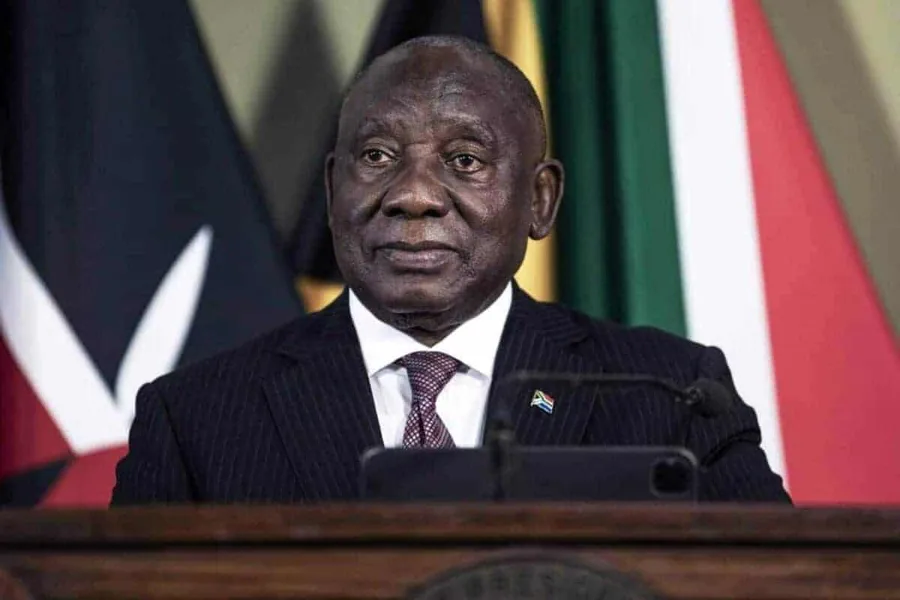
President Cyril Ramaphosa says South African women shouldn’t have to reorganise their lives due to the threat of male violence, as he condemned gender-based violence and femicide (GBVF) and announced urgent interventions.
The president emphasised that GBVF doesn’t begin with violence, rape or murder.
“It begins in attitudes that regard women as inferior. It begins with the belief that a man has the right to control a woman. It begins when jealousy is mistaken for love, when control is mistaken for protection and coercion is mistaken for affection,” Ramaphosa said.
“It begins when a man believes that because he provides financially for a woman, he owns her. It begins when a man believes that because he is powerful, wealthy or influential, he is entitled to a woman’s attention or affection. It begins when a man refuses to accept the word no”.
The president addressed the nation on Tuesday evening on the scourge of GBVF, but he emphasised that he was addressing South Africa not only as the head of state but as a man, husband and father of daughters.
‘The nation is angry’
“The nation is angry. The women of South Africa are angry. Their anger is justified. I too share that anger,” Ramaphosa said.
The president’s address comes amid a tragic series of women’s murders in Ekurhuleni. The police have been investigating the murders of 11 women in and around the metro since July 2026.
He listed the Ekurhuleni victims as well as other women across the country who have lost their lives. Ramaphosa added that there are victims who are still unknown.
“How can our hearts not be broken? How can we not be angry? The violence being perpetrated against women in our country is inhuman,” the president said.
“Behind each of these terrible deaths was a human being, a daughter, a mother, a sister, a friend, an aunt, or a grandmother, whose life had value, whose future mattered, and whose absence has left a family and a community grieving.”
Update on steps to confront GBVF
During the address, Ramaphosa provided an update on the government’s steps to confront GBVF.
He also provided an update on the investigations into the murder of about 11 women in and around Ekurhuleni since July 2026.
Earlier on Tuesday, the acting Minister of Police Firoz Cachalia confirmed that the South African Police Service (Saps) had arrested four suspects linked to some of the murders.
A further suspect killed himself as the police were closing in on him.
“We are confident that further breakthroughs will be made,” the acting minister said in a statement.
Police arrested four suspects linked to Ekurhuleni murders
Ramaphosa confirmed that police arrested a suspect in connection with the killing of Ntombifuthi Nxumalo, whose body was found on Saturday; two suspects who have appeared in court in connection with the killing of Jabulile Ntimba; and one in connection with the murder of Busisiwe Mahlangu.
Cachalia said a highly skilled, multidisciplinary team under the leadership of acting deputy national commissioner Lieutenant General Hilda Khosi Senthumule made these arrests.
The president said in the other cases, the police have identified persons of interest and collected forensic material, including DNA, blood samples, clothing, cellphones and cellphone records.
The Council for Scientific and Industrial Research (CSIR) is also assisting with the digital forensic investigation.
“At present, the police have not found evidence establishing that these killings were committed by a single perpetrator. All possibilities remain under investigation,” Ramaphosa said.
Meanwhile, Cachalia added that targeted, intelligence-led, high-visibility policing lockdown operations were underway in the affected parts of Ekurhuleni.
“These enhanced operations are part of Operation Shanela 2 and, as we did to ensure the 30 June anti-illegal immigrant protests remained peaceful, these operations have received the necessary additional financial and human resources,” Cachalia said.
“This is to give some assurance to our people there in a period of high anxiety.”
President announced four immediate directives
The president also revealed four immediate directives with specific timelines to address systemic failures.
The first directive orders a national case recovery operation to audit unresolved murders and sexual offences within 60 days, and the second directive requires a funded plan within 60 days to reduce forensic backlogs and set turnaround standards.
The third directive mandates municipal women’s safety audits to identify hazards like broken streetlights and unsafe transport routes within 60 days, and the fourth calls for a coordinated legislative package within 60 days to address alcohol-related violence.
“Every sphere of government must understand that the safety of women is part of its responsibility. Our constitutional obligation to jointly secure the well-being of all South Africans, to assist and support one another and to coordinate our actions compels us to fulfil this responsibility,” Ramaphosa said.
GBVF declared a national disaster but not enough done
On 20 November 2025, the president officially declared GBVF a national disaster.
He said that since the declaration, the National Council on Gender-Based Violence and Femicide is now operational to coordinate the national response.
Ramaphosa added that efforts include expanding sexual offences courts, strengthening DNA processing, and increasing resources for specialised police units.
However, the president conceded that these measures are not enough to prevent women from being killed.
“It has not been enough to make women safe in their homes, in our streets, on public transport, in workplaces and in places of learning. It has not been enough to change the attitudes and behaviour that enable violence against women,” he said.
Challenge to SA men and boys
Ramaphosa said most GBV occurs within intimate relationships and argued that prevention must begin in homes by teaching boys about consent, anger and respect for women.
He challenged the men and boys of South Africa to stop being silent and to confront harassment and abuse in their social circles.
“It is time for good men to stop being silent men,” the president said. He added that the responsibility for violence always belongs to the person who commits it.
“The women of South Africa should not have to fight gender-based violence alone. The men of South Africa must stand up and fight it with them. This is a fight that we must take up as a nation, together,” Ramaphosa said.
List of victims
Victims of femicide in Ekurhuleni, in order of their discovery:
- Busisiwe Mahlangu found in Kempton Park on 15 July 2026
- Itumeleng Kekana found in Kempton Park on 03 August 2026
- Nomfesane Mjobo found in Kempton Park on 26 August 2026
- Unknown woman found floating in the Clayville River in Olifantsfontein on 7 September 2026
- Gracious Nkomo found in Kempton Park on 10 September 2026
- Elizabeth Moselakgomo found in Kempton Park on 12 September 2026
- Name withheld – her name cannot yet be revealed until her family has been informed – found in Olifantsfontein on 14 September 2026
- Dineo Motapane found in Kwa-Thema on 15 September 2026
- Jabulile Ntimba found in Dawn Park on 17 September 2026
- Ntombifuthu Nxumalo found in Thembisa on 26 September 2026
- Body of yet-to-be-identified woman found in Springs on 27 September 2026
Other victims of GBVF in South Africa:
- Octavia Swarts, 10, from Kraaifontein
- Nomakhwezi Zitha from Delft
- Taymin Platt from Eersterust
- Josephine Tshabalala from Orlando East
- Siyavuya Mlunguza from Komani
- Mariette Mouton, 73, from Bredasdorp
- Christina Nyalungu, a security officer at the University of Limpopo
- Sibongile Mdali from Richmond
- Amogelang Motshwaedi, 15, from Dinokana village
- Pinky Shelembe and Ntombizana Mbanjwa from Richmond
- Amanda Kosani from Port Alfred, who was killed on Women’s Day
Follow the story
About this article
- Length
- 1,246 words · 6 min read
- Published
- September 29, 2026
- Byline
- Chulumanco Mahamba
- Source
- The Citizen