

Government appoints AI focal persons across ministries to drive national strategy

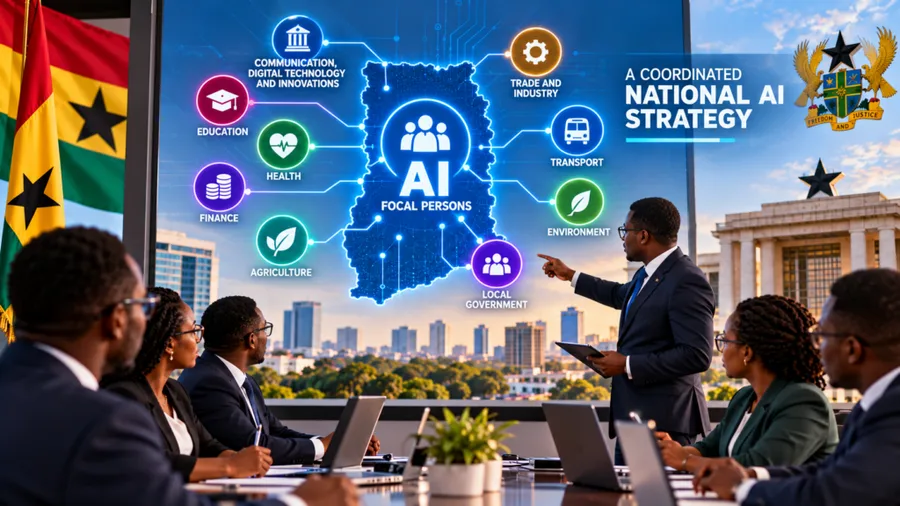
The Minister for Communication, Digital Technology and Innovations, Sam George, has disclosed that the government has appointed artificial intelligence (AI) focal persons across all ministries as part of efforts to prepare public institutions for the adoption of the technology.
He says Cabinet ministers have already undergone AI training, while preparations are underway to equip senior civil servants with the skills needed to integrate artificial intelligence into government operations.
“We’ve done the AI boot camp for cabinet ministers. We have AI-focal persons in every ministry now,” he revealed.
Speaking in an interview ahead of the second episode of the Digital Economy Forum, Mr George explained that the government is taking steps to ensure that ministries, departments and agencies develop the capacity to deploy AI responsibly and effectively.
He disclosed that Ghana has also undertaken an AI readiness assessment in collaboration with UNESCO to determine how prepared government institutions are to adopt the technology.
“Working with UNESCO, we’ve done an AI readiness assessment model that has mapped out all of the government ministries and agencies and determined the various states of readiness for our various agencies,” he explained.
According to the minister, the findings will help the government identify institutions requiring additional investment, technical support and capacity-building before introducing AI into their operations.
He said the assessment would also guide engagements between his ministry and the Ministry of Finance on the resources needed to address gaps in institutional preparedness.
The initiative forms part of Ghana’s broader national AI strategy, which seeks to harness the technology to improve economic productivity, strengthen public services and expand access to essential services.
The country’s preparedness for artificial intelligence, its impact on jobs and the opportunities for economic growth will form part of discussions at the second episode of the Digital Economy Forum, under the theme “AI and the Ghana Economy: Opportunity or Disruption?”
The forum, held in partnership with Hubtel, will feature Sam George; Technical Advisor at the Finance Ministry, Dr Theo Acheampong; Founder of AI for Ghana, Adam Watkins; Head of Engineering at Hubtel, Augustine Adjei; and Vice President of IMANI Africa, Bright Simons.
It will air live on JoyNews and Joy 99.7 FM on Wednesday, October 21, 2026, at 8 p.m.
Training senior public officials
Beyond the appointment of AI focal persons, Mr George disclosed that the government is working with the United Nations Development Programme (UNDP) and UNESCO to train senior civil servants, including chief directors and directors across public institutions.
“We’re beginning the training, working with the UNDP and UNESCO, for our civil servants, our chief director and director levels,” he said.
The training is intended to equip public officials with the knowledge required to understand and apply artificial intelligence within their respective institutions.
Mr George believes preparing the public sector is essential because the successful implementation of Ghana’s AI strategy will depend not only on investment in technology but also on the ability of government officials to use it effectively.
He explained that Ghana’s AI strategy provides a ten-year development framework with measurable objectives intended to guide the country’s adoption of the technology.
“Our AI strategy gives us a 10-year plan of what we intend to achieve, measurable plans of what we need to achieve. We’ve started work on that,” he stated.
The strategy identifies agriculture, healthcare, education and government services as priority areas where artificial intelligence could improve productivity and the delivery of essential services.
AI to improve government decision-making
The sector minister believes artificial intelligence could significantly improve how government institutions plan development projects and allocate public resources.
He disclosed that the ministry is developing a national data exchange hub intended to connect 48 data registries across government institutions.
The proposed system would allow information currently held in separate databases to be analysed collectively, helping policymakers identify development priorities using empirical evidence.
The minister argued that decisions about public investments should be guided by the actual needs of communities rather than political promises or the preferences of influential individuals.
“I think that where we should get to as a country is that our interventions in communities must be driven by hardcore empirical evidence,” he said.
He explained that data from hospitals, schools and other public institutions could help determine where resources would have the greatest impact.
The minister also outlined plans for a national AI compute centre, which he believes will provide the processing infrastructure required to analyse large volumes of government data and support AI applications across different sectors.
According to him, the government has committed US$250 million towards the first phase of the project, which is being designed with capacity beyond Ghana’s immediate requirements.
Mr George believes combining such infrastructure with improved institutional readiness could enable the government to deliver more efficient and responsive public services.
Building a digitally inclusive government
Despite the opportunities presented by artificial intelligence, the minister acknowledged that its successful adoption would require sustained investment in infrastructure, cybersecurity, data protection and human capacity.
He disclosed that the government is reviewing Ghana’s cybersecurity and data protection legislation to respond to risks associated with the increasing use of AI and large volumes of personal data.
Mr George said the objective is to ensure that Ghana takes advantage of emerging technologies while protecting citizens and strengthening the institutions responsible for delivering public services.
He expressed optimism that the implementation of the national AI strategy would ultimately help create a more responsive public sector, where citizens can access government services with greater ease.
Describing his vision for Ghana’s AI-powered future, the minister said he wants to see “a harmonised system that works for the benefit of the Ghanaian people.”
For him, the appointments, training programmes and planned infrastructure investments are steps towards a broader transformation of the Ghanaian economy.
Follow the story
About this article
- Length
- 954 words · 5 min read
- Published
- October 17, 2026
- Byline
- Emmanuel Dzivenu
- Source
- Joy News