

Leaders South Africa has yet to learn to celebrate

AI summary
When a black professional reaches the top of a strategic institution in South Africa, their arrival is rarely presented as news about one person.
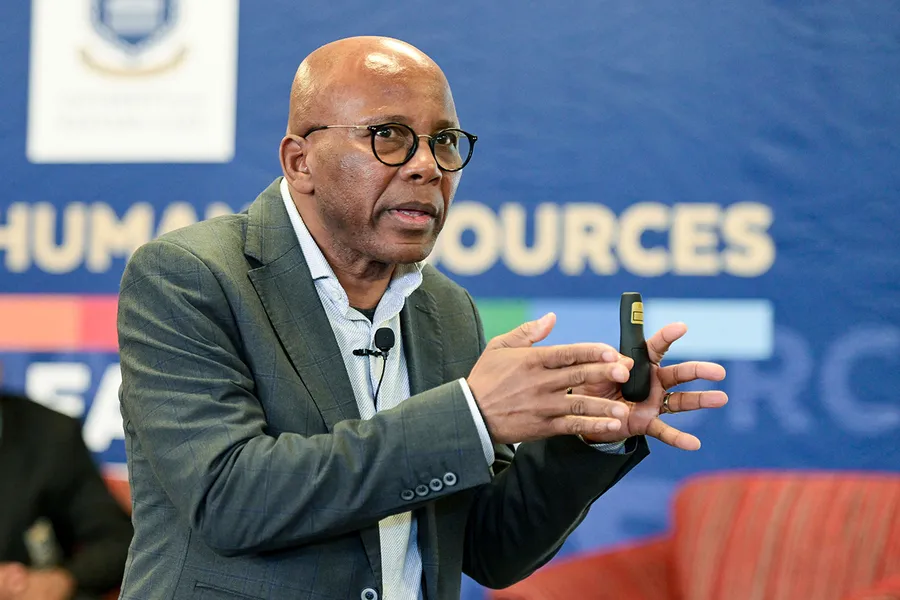
Transformation remains highly contested even after 32 years of democracy. That is why the reappointment of Mteto Nyati as chairperson of Eskom for a further three years matters well beyond Megawatt Park.
The Black Business Council welcomes it for reasons that are symbolic and strategic.
Media personality Redi Tlhabi’s recent column in Daily Maverick asked why South Africa finds it so difficult to credit black leadership with success. The Black Business Council would add a second question: What does it cost the country when that credit
is withheld?
Not long ago, families cooked by candlelight and planned their lives around load-shedding schedules. Many respected analysts warned that the grid would not stabilise for years.
That forecast has not come to pass. Load-shedding has effectively ended, the grid has stabilised and Eskom has returned to profitability. Thousands of Eskom employees did the work on the ground. Under Dr Nyati as chair and Dan Marokane as chief executive, the work was given direction, discipline and protection from distraction.
Few state-owned enterprises have moved from sustained crisis to stability so quickly.
Eskom’s recovery remains unfinished, and difficult decisions on transmission investment, municipal debt and market reform lie ahead. But the country faces those decisions from a position of strength rather than emergency. That shift did not happen by itself.
Nor is this Nyati’s first success. Over a career spanning nearly four decades, he has built a record that would be celebrated in most economies. Trained as a mechanical engineer at the then University of Natal, he began his career at Afrox, spent more than a decade at IBM and later led Microsoft South Africa as managing director.
At MTN he helped return a struggling business to growth. At Altron he steered a group, founded during apartheid, into a new era.
It is not by accident that Nyati titled his memoir Betting on a Darkie. The title is uncomfortable by design. It names the wager South African institutions have long hesitated to make and the burden carried by those on whom the bet is placed. Early in his career, he was often the only black engineer in the room, advised above all not to fail.
Nearly four decades later, he is still asked to prove what his record shows.
A pattern of that kind is not an accident. It is a method. Business schools, which rightly teach the turnarounds of global corporations, would do well to study Dr Nyati as a case in what transformed leadership looks like: engineering depth, commercial discipline and a steady hand in institutions under strain.
Yet South Africa has a curious way of assigning authority. André de Ruyter led Eskom through the most severe load-shedding the country has experienced. He continues to be sought out as a leading voice on the utility’s future, while leaders associated with its recovery are often asked to justify their place.
Why do De Ruyter’s words seem to carry an authority his results did not earn?
Nyati has not been beyond criticism, nor should he be. His caution on the pace and sequencing of unbundling has drawn sharp responses from parts of organised business and the energy commentariat.
The council supports reform of the electricity sector. We also recognise that a chair who asks how restructuring will affect Eskom’s debt and obligations to lenders is exercising fiduciary duty, not resisting change. A prominent energy commentator who called for his departure in August has since praised his leadership as quiet, authoritative and principled. The shift is welcome. It also shows how quickly caution from a black leader can be read as obstruction.
The strategic case extends beyond Eskom. Energy, transport, water, ports and digital infrastructure will shape the country’s growth for a generation. Black engineers, financiers and executives are building careers in these sectors. What they watch closely is how the country treats those who reach the top.
For the Black Business Council, transformation in strategic sectors is not a favour extended to black professionals, but a test of whether the country uses the full depth of its talent where the stakes are highest.
After years in which Eskom’s leadership came and went with alarming speed, continuity at board level also offers what the utility has lacked most: stability long enough to finish the job.
South Africa’s history has left a lingering assumption that black leaders hold their positions on sufferance. Nyati’s reappointment offers a chance to retire that assumption.
The council will continue to stand with black professionals who build and lead the institutions this country depends on. We will also keep asking a question that reaches beyond one boardroom: How many Mteto Nyatis are out there, fighting for their survival, when they should be celebrated?
- Matabane is the chief executive of the Black Business Council.
Follow the story
About this article
- Length
- 816 words · 4 min read
- Published
- October 4, 2026
- Byline
- Kganki Matabane
- Source
- Sunday World